.avif)


Obtenga el suyo gratis Guía de autonomía de drones ¡Hoy!

Every operations leader agrees on the promise of automation. The technology is mature, the ROI proven, the use cases everywhere — yet many enterprise drone programs still stall after pilots.
Across 2025, FlytBase’s market intelligence revealed a consistent pattern: even as autonomous drone systems show measurable returns, decision-makers hesitate to treat them as infrastructure. This creates what we call the $40K paradox, the moment when a drone system, costing about USD 40,000 per site, is seen as expensive innovation rather than operational investment.
Why the $40K price tag feels bigger than it is
When enterprises evaluate autonomous drones, the discussion often starts, and ends, with cost. A docked drone system, including hardware, software, and deployment, typically ranges between USD 30,000–50,000 per site. On paper, that seems steep compared to a manual guard route or a contractor with a handheld drone.
But those comparisons miss what automation replaces:
- Travel and inspection labor hours
- Downtime from weather or access delays
- Repeated manual checks and insurance overhead
- Workforce exposure in high-risk zones
Across FlytBase deployments, automated inspection and security workflows have cut operating costs by 60% or more while removing nearly all human exposure in restricted areas. The hesitation, then, isn’t financial; it’s psychological.
How can enterprises bridge the perception gap?
Through hundreds of customer conversations analyzed by FlytBase, a recurring insight emerged: many organizations still file drone programs under “innovation” instead of “infrastructure.”
That single label drives how programs are funded, staffed, and scaled. When seen as experimental, they’re funded like pilots. When viewed as infrastructure, they receive capital investment, the same way companies fund servers, cameras, or SCADA systems.
This perspective shift made all the difference for Premier Security. Once the team integrated docked drones into their core perimeter operations, rather than treating them as a standalone pilot, reporting time dropped by more than half, and field coverage became entirely automated.
A similar transformation unfolded at Titan Protection. By repositioning drone autonomy as operational infrastructure, Titan achieved a 60% reduction in security costs and 40% fewer incidents across multi-site deployments. What started as a single-site trial quickly became an enterprise model for automated patrols.
Why early pilots often fail to scale
Pilot projects succeed technically but stall strategically. A single site may show a 50% gain in coverage or inspection time, but executives rarely see cross-site impact unless data rolls up across locations.
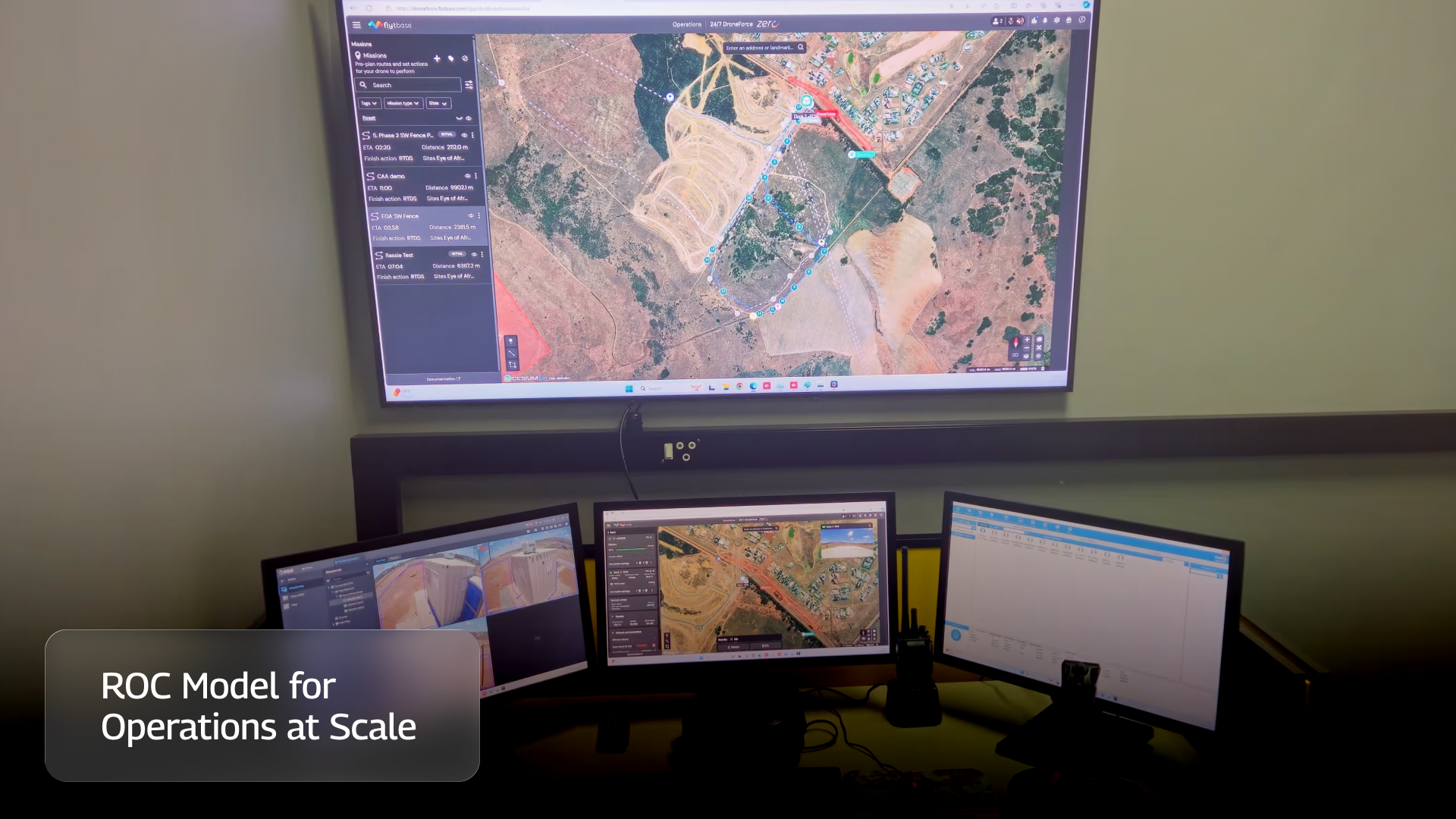
That’s where unified orchestration matters. Platforms like FlytBase connect every dock, flight, and report in one system — transforming scattered pilots into scalable infrastructure.
When Anglo American linked its autonomous inspection missions under a single FlytBase dashboard, it achieved a 90% cut in travel time and unified reporting across operations. What began as a regional test became a global standard.
What enterprises actually gain from automation
Automation doesn’t just reduce labor; it creates predictability. With FlytBase-managed docked drones, enterprises gain:
- Fixed cost control, removing overtime variability
- Consistent, structured data for compliance and audits
- Scalable deployment across multiple sites
- Seamless integrations with VMS, SCADA, or analytics tools
Each advantage compounds over time. When enterprises measure drones by output per flight instead of cost per drone, automation becomes an asset class.
Overcoming the paradox
The $40K paradox disappears when automation is seen not as an add-on, but as the backbone of operations. Once enterprises reframe drone systems as infrastructure, cost becomes ROI. FlytBase enables that shift by giving operations, IT, and security teams a unified platform to plan, execute, and analyze autonomous drone missions at scale.
To see how Anglo American and Premier Security reframed automation economics, explore the FlytBase Case Study Library.
Preguntas frecuentes
Encuentre respuestas rápidas a preguntas frecuentes sobre compatibilidad, configuración, funciones y precios
It’s the misconception that autonomous drone systems are too expensive to justify. In reality, enterprises lose more through manual inefficiency than they would spend automating. The paradox reflects a mindset gap, not a financial one.
Most organizations categorize drone projects as “innovation pilots” rather than infrastructure investments. This limits budgets and prevents scale, even when early trials show clear ROI. FlytBase helps enterprises standardize and scale, transforming automation from an experiment into a core operational system.
Across FlytBase deployments: Titan Protection cut security costs by 60% and reduced incidents by 40%. Premier Security automated patrol workflows and improved SLA compliance across sites. Anglo American achieved a 90% reduction in inspection travel time. These cases show real-world ROI between 150–250% in the first year.
Instead of comparing upfront costs to headcount or contractor fees, CFOs should measure: Downtime saved from faster inspections, Insurance and safety savings, and Multi-department data reuse (security, maintenance, ESG). FlytBase data shows automation ROI typically exceeds 200% within one year, making it an infrastructure-grade investment.
.webp)
.svg)
.webp)
.png)
