.jpg)





Obtenga el suyo gratis Guía de autonomía de drones ¡Hoy!

When more than 1.2 million people move through a city each day, public safety stops being reactive. It becomes architectural.
During Brazil’s Carnival 2026, the Bahia State Civil Police, in coordination with OCA Drones, deployed a coordinated autonomous drone network designed for persistent, city-scale aerial visibility.
This was not a pilot. It was live operations during one of the largest public gatherings in the world.
Crowd Density Doesn’t Wait for Incident Reports
Carnival stretches across urban corridors and shoreline zones. Crowd movement shifts hourly. Agencies operate in parallel. Small visibility gaps can escalate quickly.
Traditional drone programs respond to incidents. A drone launches after a call. It supports a moment. It returns.
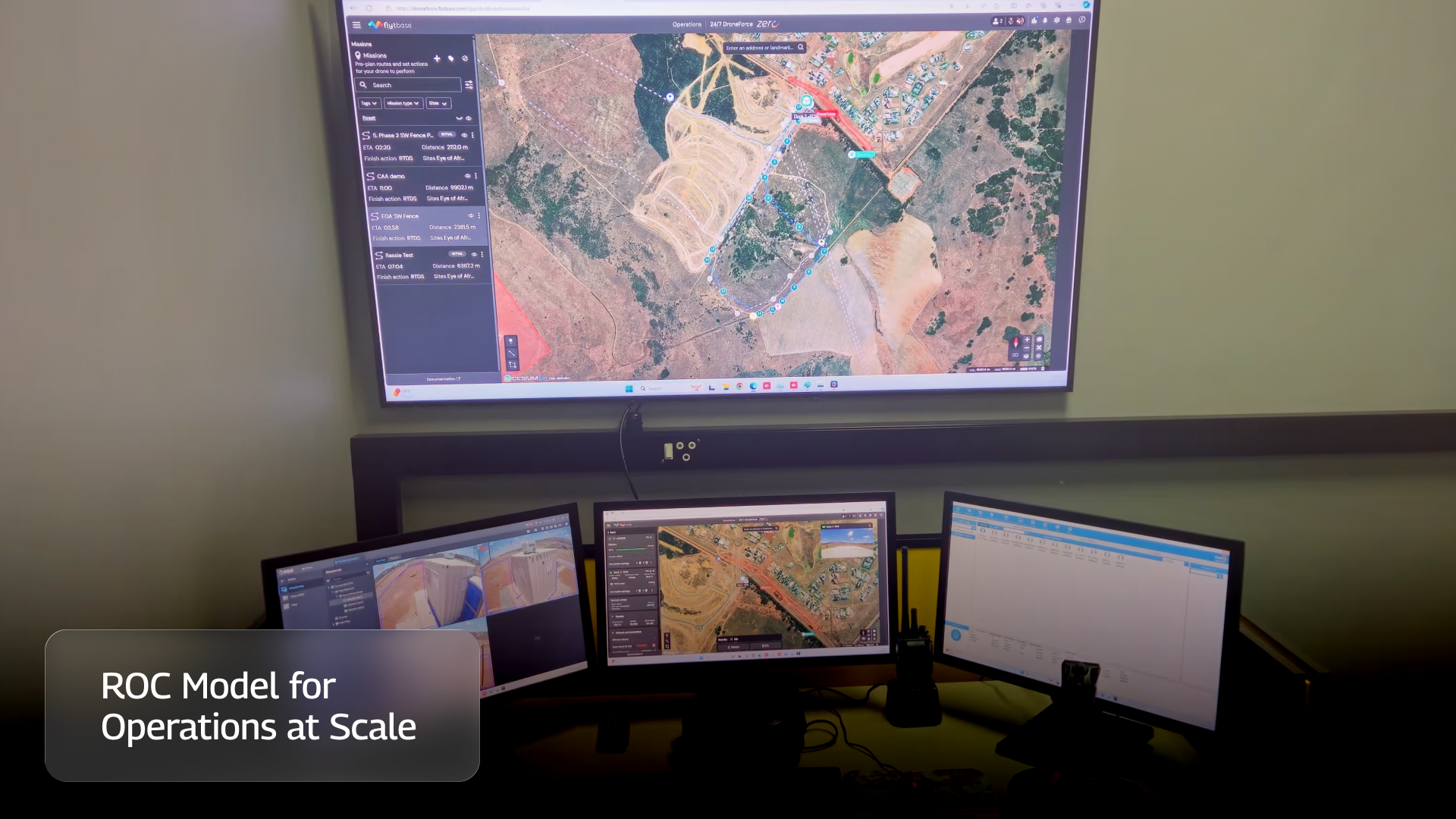
That model doesn’t scale to a million people. Instead, OCA Drones coordinated a structured aerial operations framework powered by FlytBase’s Remote Operations Center and integrated with Verkos Detect Anything Agents for real-time AI detection.
The goal was persistent situational awareness, not episodic response.

A Hybrid Architecture: 7 Non-Docked and 1 Docked Drone
The deployment combined mobility with automated persistence:
- 7 non-docked autonomous drones for adaptive sector coverage
- 1 docked drone-in-a-box system for continuous shoreline patrol
- Centralized mission planning and fleet orchestration through FlytBase
- Real-time AI analytics powered by Vrkos Detect Anything Agents
- Field coordination, drone logistics, and operational oversight led by OCA Drones
Non-docked drones allowed rapid redeployment as crowd density shifted across districts. The docked system delivered repeatable patrol routes in high-density shoreline zones without requiring constant manual intervention.
This hybrid model ensured coverage flexibility while maintaining continuous monitoring in critical areas.
AI-Driven Detection Inside the Operational Workflow
Live video alone does not solve operational overload.
Verkos Detect Anything Agents processed aerial feeds in real time, enabling predefined detections and automated alerts within the Integrated Operations Center.
Instead of relying solely on human monitoring, command teams received structured, actionable inputs.
The integration supported:
- Faster identification of developing crowd risks
- Continuous shoreline activity assessment
- Shared operational visibility across agencies
- Reduced cognitive load during peak hours
FlytBase handled autonomous flight control and mission orchestration. OCA Drones ensured coordinated execution across all aircraft. AI systems converted aerial footage into operational intelligence.
Together, the system functioned as embedded infrastructure.

What This Deployment Signals for Public Safety Agencies
This deployment signals a shift in how public safety agencies approach large-scale events.
Autonomous drones are no longer limited to reactive dispatch. When coordinated through a centralized command architecture and supported by AI-driven detection, they become a persistent aerial layer integrated into city operations.
Carnival 2026 demonstrated that:
- Hybrid docked and non-docked architectures can scale across dense urban environments
- AI-driven workflows reduce monitoring fatigue during high-pressure events
- Autonomous drone networks can function reliably at million-person scale
As public events grow more complex, agencies are moving beyond manual drone programs toward coordinated aerial intelligence systems. Carnival showed that model performing in real-world conditions.
To learn more about public safety: https://www.flytbase.com/industries/public-safety
Preguntas frecuentes
Encuentre respuestas rápidas a preguntas frecuentes sobre compatibilidad, configuración, funciones y precios
During Brazil’s Carnival, the Bahia State Civil Police deployed a hybrid network of 8 autonomous drones integrated with the FlytBase Remote Operations Center. Seven non-docked drones provided dynamic crowd coverage, while one docked drone-in-a-box system delivered continuous shoreline patrols. Real-time AI analytics processed aerial data and delivered alerts directly into the command center.
A hybrid autonomous drone architecture combines docked drone-in-a-box systems for persistent monitoring with non-docked drones for flexible, mobile coverage. In this deployment, docked drones handled fixed high-density zones, while mobile units responded to shifting crowd patterns across urban corridors.
AI-powered video analytics processed live aerial feeds in real time. Instead of manually monitoring raw footage, agencies received structured alerts for predefined risk scenarios. This reduced cognitive load, accelerated risk identification, and improved cross-agency coordination.
Large public gatherings create rapidly shifting crowd densities and coordination challenges. Autonomous drones provide persistent situational awareness, centralized mission control, and real-time intelligence sharing across agencies, enabling faster and more informed decision-making.
.webp)
.svg)
.webp)

.png)
