.avif)


Obtenga el suyo gratis Guía de autonomía de drones ¡Hoy!

Construction sites record over 167,000 lost-time injuries every year, costing the industry billions in lost productivity and compensation. But what if a construction company could reduce unsafe conditions by nearly 90% within just three weeks?
That’s what organizations deploying AI-powered helmet detection systems with autonomous drones are achieving through the FlytBase Platform.
Why Human Monitoring Misses 35% of Safety Violations
Traditional site monitoring depends on supervisors patrolling multiple areas and hoping to catch violations in time. The reality is sobering:
- Manual inspections effectively cover only 2–3 areas per hour
- Fatigue and distraction cause observers to miss 35% of safety breaches
- Continuous 24/7 coverage is expensive and often inconsistent
One construction customer summarized it best during a FlytBase demo:
“Our supervisors simply can’t be at every location at once — especially across multiple towers.”
This gap between intent and visibility is exactly where AI-powered automation steps in.
How Edge AI Makes Real-Time Helmet Detection Possible
Unlike static CCTV systems, FlytBase-enabled autonomous drones provide continuous, intelligent, and mobile coverage across large construction zones.
1. Edge Intelligence in Motion
At the heart of this capability lies AI-R Edge, FlytBase’s compact accelerated compute unit that processes video on-site. While most systems need cloud connectivity to identify safety gear, AI-R performs real-time helmet detection even when drones are moving or when network quality drops. This means instant detection of yellow helmets — the visual proxy for PPE compliance — without relying on constant internet.
2. 24/7 Autonomous Patrols
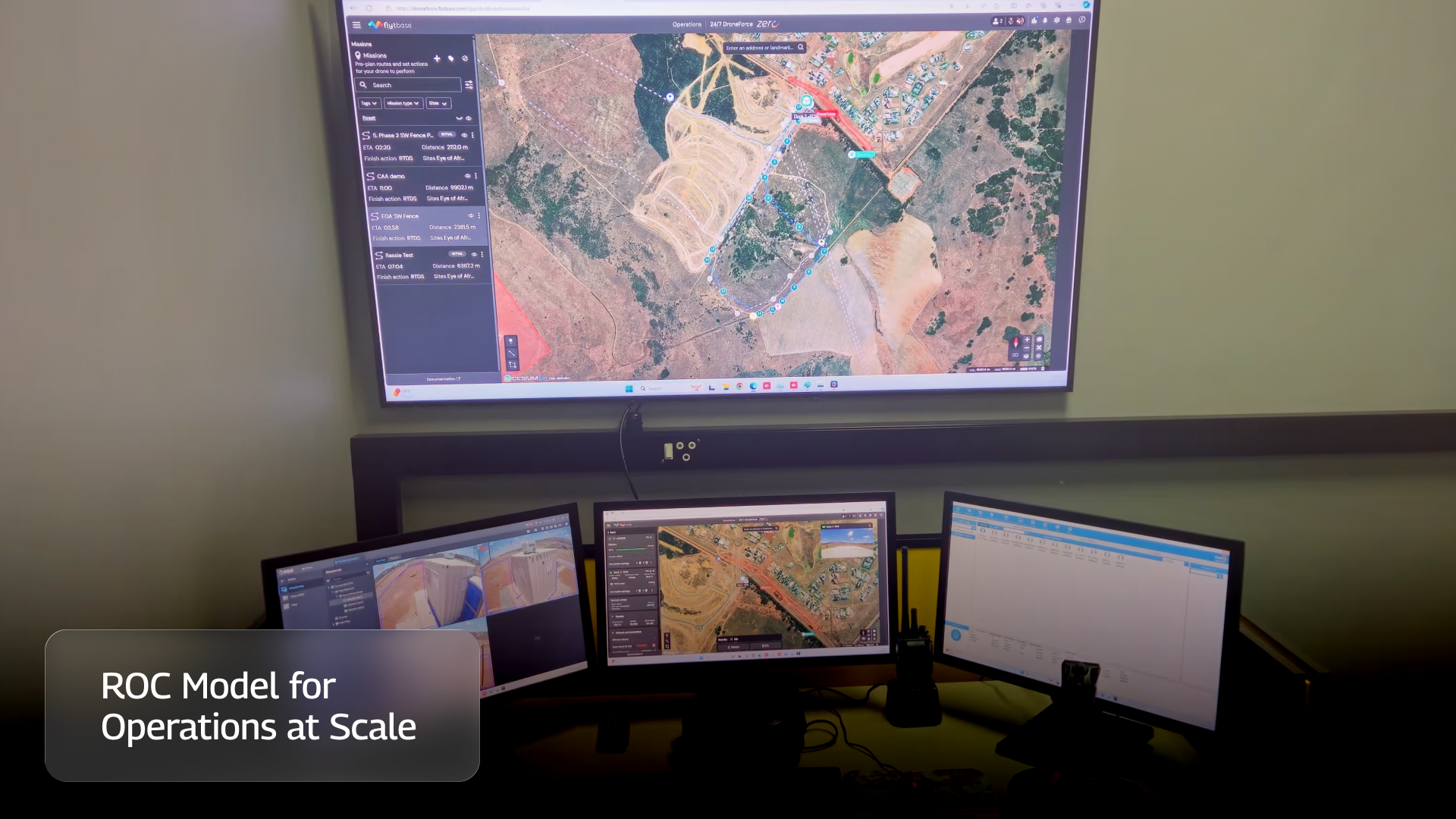
Once deployed, drones automatically launch from their docking stations, follow scheduled patrols, detect PPE violations, and return for charging — all without human pilots. Every mission log, video stream, and alert is synchronized to the FlytBase Remote Operations Center (ROC), enabling round-the-clock visibility.
3. Enterprise-Grade Reliability
Through FlytBase Shield, each operation runs with multilayer security — encrypted command links, single-sign-on control, and automated failsafe mechanisms for safe recovery in the event of RC link or LTE loss. Optional autonomous parachute systems ensure safe landings, meeting enterprise risk-management standards.
4. Multi-Stakeholder Live View
Project managers, HSE officers, and executives can all access live feeds from different drones simultaneously, with bandwidth-optimized streaming for low-connectivity sites. This feature was critical for a customer preparing deployment at a famous automobile factory, where network latency previously disrupted other systems.
5. Custom AI Models for PPE Detection
FlytBase allows customers to train AI models for their own safety gear, whether that’s yellow helmets, reflective vests, or zone access indicators — ensuring detection fits internal safety policies, not just generic datasets.
Quantified Impact: From Visibility to ROI
Customers deploying AI-driven helmet detection have reported immediate operational benefits:
Performance Gains
- 50% faster inspection cycles than manual patrols
- 30% fewer human errors in hazard detection
- 89% reduction in unsafe conditions within three weeks
Financial Outcomes
- Up to 200% ROI within two years
- 10–15% productivity increase across monitored sites
- Elimination of staff exposure in hazardous or hard-to-reach zones
A mid-sized contractor even monitored five construction sites simultaneously during a 12-month proof-of-concept — something impossible under manual supervision.
Connectivity and Signal Intelligence: A Hidden Success Factor
Construction sites often struggle with unreliable LAN or 4G coverage. FlytBase includes a signal-strength heat-mapping utility that identifies red-zone drop-offs before deployment, allowing teams to add boosters proactively.
As a popular factory team shared after a demo:
“Seeing our weak-signal zones early saved weeks of installation rework.”
This small but critical insight prevents failed missions and downtime.
Beyond Helmets: The Next Frontier of Site Safety
Today, AI-R detects helmets. Tomorrow, it will identify vests, safety harnesses, restricted zones, or machinery intrusions — creating a unified layer of autonomous site safety intelligence. This evolution is already underway as AI-R deployments expand from construction into mining and energy operations, where similar safety monitoring challenges exist.
“This gives us the detection capability we need — without changing our DJI infrastructure,” said a customer during an enterprise evaluation.
Why Enterprises Choose FlytBase
FlytBase’s differentiation lies in three enterprise pillars:
- Hardware-agnostic design: Works seamlessly with DJI and third-party docks or drones.
- AI-R Edge computing: Enables detection in motion and in low-connectivity zones.
- FlytBase Shield: Guarantees compliance, encryption, and reliability at scale.
These capabilities together transform drones from visual sensors into autonomous safety agents.
Ready to See It in Action?
Experience how AI-powered helmet detection can elevate safety and compliance across your sites. FlytBase offers a free trial with full support, helping you evaluate impact on your specific operations.
Preguntas frecuentes
Encuentre respuestas rápidas a preguntas frecuentes sobre compatibilidad, configuración, funciones y precios
FlytBase uses an edge AI module called AI-R Edge that processes video streams directly on-site. Drones patrol autonomously, capture live footage, and the AI model detects whether workers are wearing safety helmets. Since the analysis happens locally, detection remains accurate even when internet connectivity is poor. Alerts and event logs are automatically pushed to the FlytBase dashboard for review or escalation.
The system updates its site map dynamically. Each patrol captures new terrain imagery that syncs to FlytBase’s ROC (Remote Operations Center). For rapidly evolving projects, you can overlay the latest 3D models of your site via Flinks integrations, ensuring accurate monitoring even as new structures go up.
Most construction teams go live within 7–10 days. Setup includes dock calibration, AI model configuration (for yellow helmet detection), and a one-day operator training. After that, drones run on scheduled patrols or can be dispatched automatically by event triggers.
Absolutely. The AI model is modular — you can add vest, glove, boot, or harness detection based on your site’s PPE matrix. FlytBase supports custom dataset training through its AI-R console, letting you expand capabilities without extra hardware.
.webp)
.svg)
.webp)
.png)
