


Obtenga el suyo gratis Guía de autonomía de drones ¡Hoy!


As autonomous drone deployments expand across mining, security, and public safety, regulatory readiness has become the single biggest factor determining scalability.
Australia’s Civil Aviation Safety Authority (CASA) requires operators to demonstrate not only flight safety but also systemic redundancy — meaning the software, hardware, and human processes behind every drone-in-a-box operation must prove consistent safety standards.
In FlytBase’s latest Platform Connect webinar, experts from FlytBase and FlyFreely unpacked what it takes to build a CASA-ready Remote Operation Center (ROC) — from architecture and data security to workflow automation and regulatory documentation.
The Four Pillars of a CASA-Ready ROC
1. Unified Operations Center
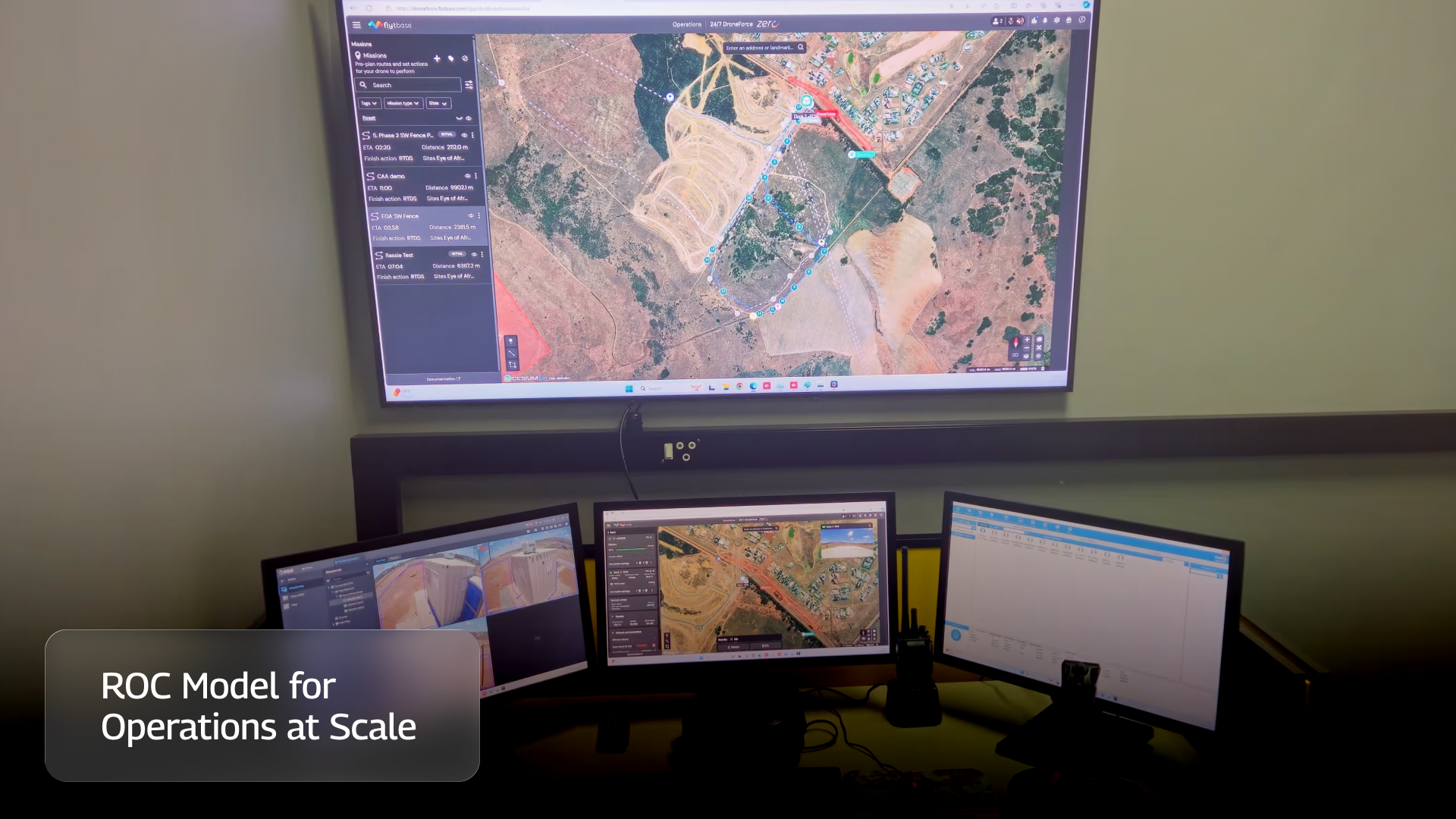
An ROC is the command and control hub for all your autonomous assets. Platforms like FlytBase consolidate live telemetry, multi-camera feeds, and airspace overlays into one dashboard, allowing operators and regulators alike to verify mission safety in real time.
Core capabilities:
- Multi-dock fleet control and status visibility
- Live video wall for situational awareness
- Real-time alerts for weather, airspace conflicts, or signal drops
- Go-to-safe-altitude and auto-recovery protocols
“CASA expects consistency,” noted Nupur Jhaveri. “If one pilot manages three docks, each site must mirror the same safety and redundancy standards.”
2. Compliance Automation Layer
Manual record-keeping slows down approvals. FlytBase’s integration with FlyFreely automates compliance documentation — every mission log, checklist, and override is time-stamped and stored for CASA audits.
- Automatic generation of CASA-compliant flight reports
- Integrated pre-flight checklists and audit trails
- UTM integration for BVLOS tracking and visibility
Zac Kennedy emphasized that CASA now prioritizes repeatable, standardized setups: “If a regulator visits one FlytBase-powered ROC in Sydney or another in New Zealand, they should see the exact same structure and control logic.”
3. Cross-Department Integration
Modern ROCs break silos by connecting data across departments: security, maintenance, inspection, and IT. FlytBase uses Flinks connectors to unify:
- Security systems like Genetec and Milestone
- GIS and mapping platforms such as Esri, DroneDeploy, Pix4D, and Strayos
- Analytics tools like SenseHawk for solar monitoring
This multi-layered visibility aligns with CASA’s “systemic redundancy” principle, redundancy in process integrity, not just hardware.
4. Data Security and Governance
Data protection is now an audit criterion. FlytBase Shield meets ISO 27001 and SOC 2 Type II standards, with flexible deployment models, from air-gapped networks to in-country clouds, addressing enterprise and government compliance requirements.
This ensures every data packet, from live video to telemetry, adheres to CASA’s approved data-integrity framework.
Common Challenges in CASA Approvals
Zac Kennedy outlined four recurring regulatory hurdles:
- Airspace Integration: Limited data and undefined priority rules for drones vs. crewed aircraft.
- Technology Reliability: Need for verifiable detect-and-avoid systems and redundancy logic.
- Workforce Training: Remote pilots require aviation-grade training for multi-aircraft control.
- Approval Bottlenecks: Manual, case-by-case processes extending timelines up to 18 months.
Recent updates, including CASA’s adoption of the SORA 2.5 framework, aim to shorten review times for low-risk BVLOS operations, a promising shift toward scalable autonomy.
Real-World Deployments
- Premier Security (South Africa): Centralized ROC managing autonomous perimeter patrols across estates, integrating FlytBase and Genetec.
- Mining & Energy Sites (Australia): Multi-dock deployments where FlytBase dashboards provide fleet visibility, compliance automation, and live redundancy proofs for CASA inspections.
- Global Benchmarks: Countries like New Zealand and Rwanda lead by adopting performance-based rules that favor demonstrable safety outcomes over prescriptive regulations.
Practical Setup Considerations
Kennedy also shared operational tips drawn from real ROC deployments:
- Power redundancy: Uninterruptible power supplies and dual network failovers (e.g., fiber + Starlink).
- Ergonomics: Backup pilots, rotation protocols, and clear human–machine interface standards.
- Emergency readiness: “Go bags,” secondary control stations, and regular simulation drills.
- Process documentation: Demonstrate not just automation, but how your team responds under pressure.
How FlytBase + FlyFreely Streamline CASA Compliance
Together, the two platforms cover the full compliance spectrum:
- FlytBase: Autonomous flight orchestration, fleet control, real-time telemetry, and data security.
- FlyFreely: Operational logbooks, audit trails, and automated report generation for CASA submissions.
This partnership helps enterprises achieve faster regulatory readiness — reducing approval cycles while maintaining the consistency inspectors expect.
Key Takeaways
- CASA-ready ROCs require repeatable safety logic, not isolated systems.
- Unified dashboards + automated compliance = faster audits.
- Data governance (ISO 27001/SOC 2) is now non-negotiable.
- Partner ecosystems like FlytBase × FlyFreely accelerate both operational scale and approval speed.
“Go in well-prepared,” Kennedy advised. “Once regulators trust your systems and documentation, scaling becomes dramatically easier.”
Next Steps
If you’re building or upgrading your Remote Operation Center, explore how FlytBase and FlyFreely enable CASA-ready workflows through automation, integration, and verified compliance.
Preguntas frecuentes
Encuentre respuestas rápidas a preguntas frecuentes sobre compatibilidad, configuración, funciones y precios
A CASA-ready ROC is a centralized command center that enables compliant, beyond-visual-line-of-sight (BVLOS) drone operations. It combines unified fleet control, automated compliance reporting, and certified data security to meet CASA standards.
FlytBase provides pre-flight checklists, geofencing, UTM integration, and automated mission logs. Combined with FlyFreely’s audit tools, it generates CASA-compliant documentation automatically.
Initial BVLOS or ROC approvals can take 12–18 months, but new CASA frameworks (SORA 2.5) and standardized FlytBase–FlyFreely setups will significantly reduce this timeline.
Unified operations dashboard, automated compliance layer, cross-department integration, and secure data governance.
.webp)
.svg)
.webp)
.png)
