.png)





Obtenga el suyo gratis Guía de autonomía de drones ¡Hoy!

Most autonomous drone programs do not fail during the pilot phase.
They fail when the organization tries to scale them.
The first few deployments usually work well. A dock is installed, patrols run reliably, and the initial use case proves its value. The technology performs as expected.
But when leadership asks what it would take to expand the program across multiple facilities, the conversation changes.
The question is no longer whether the drone works. The question is whether the investment justifies expansion. This is where many programs stall.
The Single-Use Trap
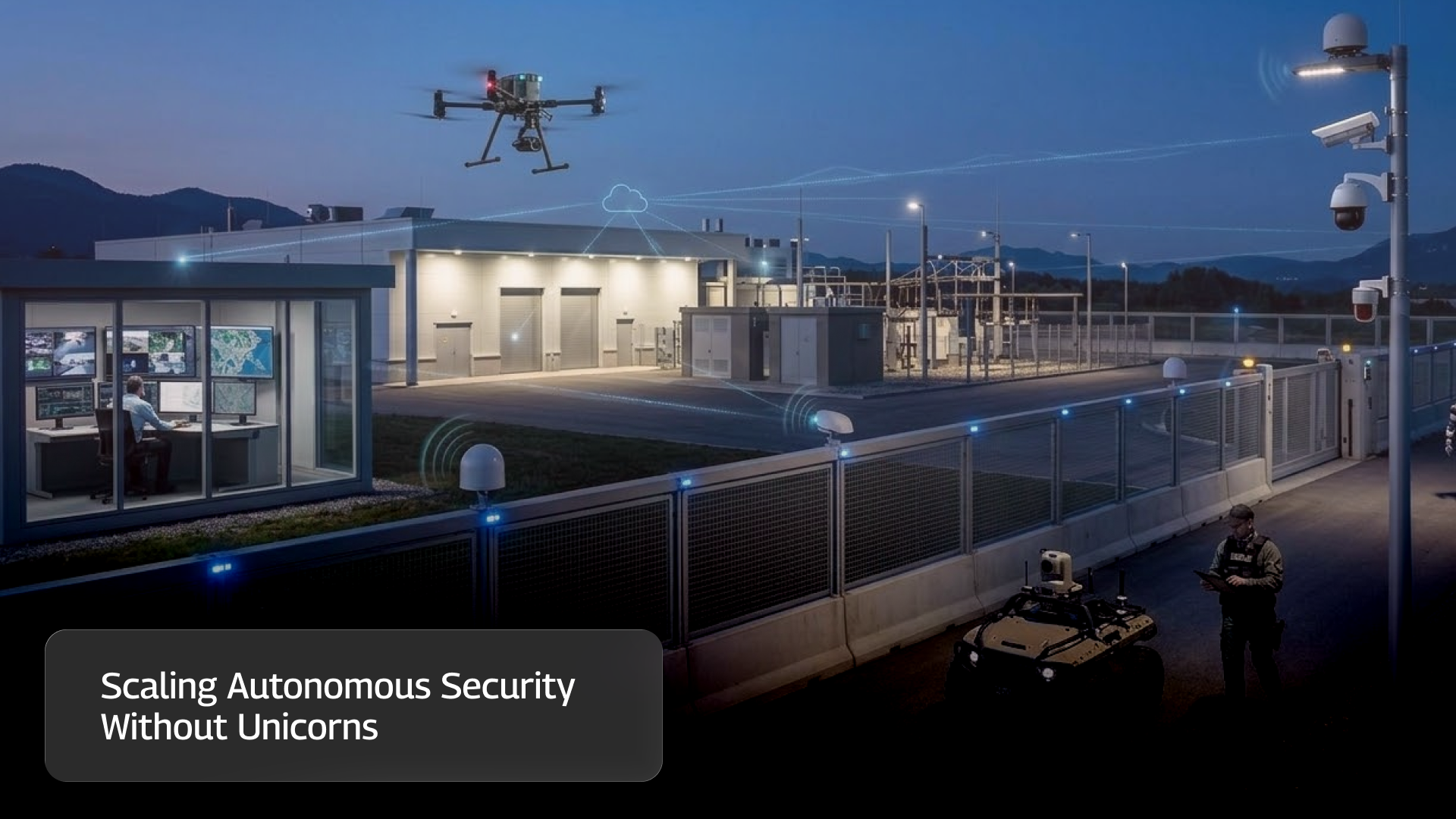
Most dock deployments begin with a single use case, often security. The system performs patrols, verifies alarms, and provides situational awareness across a facility.
Operationally, the value is clear.
Financially, however, the return is limited to one department’s budget.
When expansion requires additional docks, infrastructure upgrades, and operational resources, that single department must justify the entire investment. Even if the system works well, the economics often fail to support large-scale deployment.
As a result, many organizations remain stuck in the pilot stage.
The technology works, but the business case does not scale.
The problem is not that the value is missing. The value exists. It is simply confined to one department.
When One Dock Serves Many Teams
The economics change the moment a second department begins using the same dock.
A dock originally deployed for security patrols can also support inspection workflows. Facilities teams can use the same system to monitor equipment or verify maintenance conditions. Construction teams can track site progress. Environmental teams can monitor compliance or survey assets.
Once multiple teams rely on the same infrastructure, several things happen at once.
Utilization increases because the system operates more frequently across different workflows. Operational costs are distributed across departments rather than absorbed by one. Most importantly, the investment is supported by multiple cost centers rather than a single budget.
What began as a specialized tool becomes a shared platform.
That shift fundamentally changes the conversation with leadership.
Instead of asking whether drones justify investment for one department, the organization begins evaluating an infrastructure system that supports several operational functions.
Why Multi-Use Has Been Difficult
Most organizations already recognize that drones can support multiple types of work. Security, inspection, facilities management, and construction teams all see potential applications.
The difficulty has never been identifying use cases.
The difficulty has been operationalizing them.
Each department operates with its own language, workflows, and expertise. Security teams think in terms of patrol zones and incident response. Inspection teams focus on assets and defect tracking. Facilities teams track maintenance routines and compliance logs.
Traditional drone operations require knowledge of flight planning, safety procedures, and regulatory compliance. Expecting every department to learn those details quickly becomes unrealistic.
This challenge is closely connected to the expertise dilemma many organizations face. When drone expertise and domain expertise must exist in the same person, scaling becomes extremely difficult.
Separating those responsibilities changes the equation.
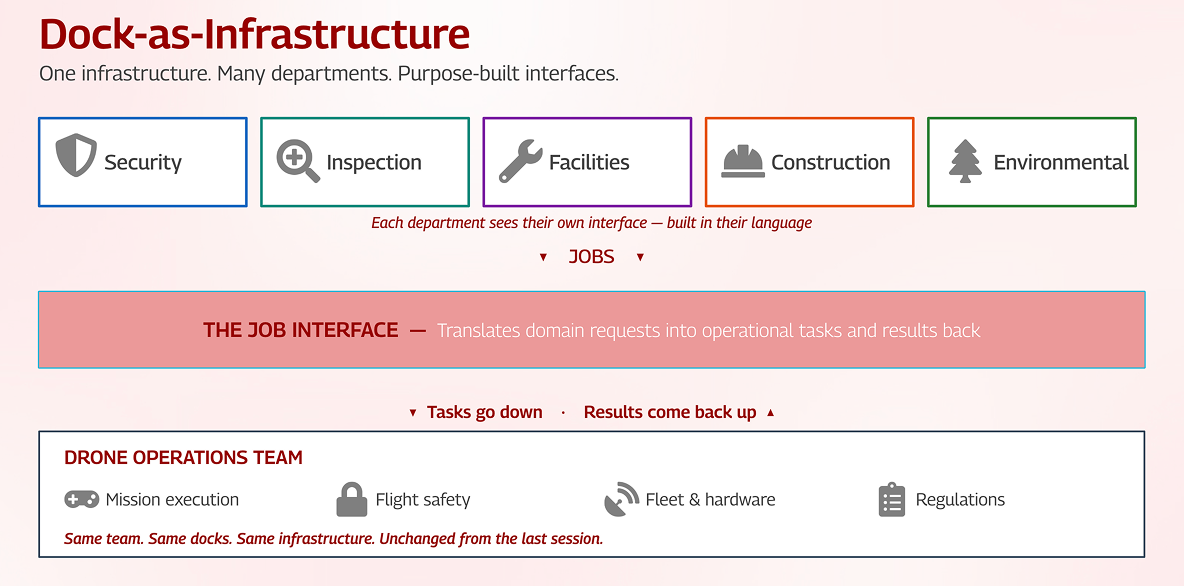
Once domain experts can submit requests in their own language while a dedicated operations team manages the drones themselves, multiple departments can share the same infrastructure without creating operational chaos.
The Shift From Equipment to Infrastructure
Infrastructure systems share three important characteristics.
They are used by many departments rather than owned by one. They are operated and maintained by a dedicated team responsible for reliability and safety. And each group interacting with the system does so through interfaces designed for their own workflows.
Corporate networks work this way. Wi-Fi systems work this way. Building management systems work this way.
Autonomous drone docks can follow the same model.
Security teams define patrol coverage and incident response tasks. Inspection teams request asset checks and defect monitoring. Facilities teams schedule routine operational rounds.
Those requests are translated into operational jobs executed by a drone operations team responsible for fleet management, flight safety, and regulatory compliance.
Once missions are completed, results return to each department in the context that matters to them.
Security receives alerts and coverage reports. Inspection teams receive imagery and asset data. Facilities teams receive maintenance verification and compliance records.
Each department interacts with the system differently.The infrastructure beneath them remains the same.
The Scaling Equation Changes
When docks operate as infrastructure rather than equipment, the scaling equation shifts.
A dock serving only one department will always struggle to justify expansion. A dock serving multiple departments operates under a completely different economic model.
Budget contributions come from several cost centers. Utilization increases as more workflows depend on the system. Each new location added to the network creates value across multiple operational domains.
The drone operations layer remains constant. The same docks, operational team, and infrastructure serve every department consuming the system.
What scales is not the operations layer itself. What scales is the number of teams relying on it.
The Moment Pilot Programs Become Enterprise Platforms
Autonomous drone deployments do not scale because the hardware becomes better.
They scale when organizations change how they think about the system.
When docks are treated as specialized equipment owned by one department, expansion will always be difficult. The program remains limited by a single budget and a single operational justification.
When docks are treated as shared infrastructure, the system becomes relevant to the entire organization.
Multiple departments rely on it. Multiple budgets support it. Multiple workflows generate value from the same underlying platform.
At that point, the conversation with leadership changes.
The question is no longer whether drones justify expansion.
The question becomes whether the organization should expand infrastructure that several teams already depend on.
That is the moment when pilot programs begin to turn into enterprise platforms.
Preguntas frecuentes
Encuentre respuestas rápidas a preguntas frecuentes sobre compatibilidad, configuración, funciones y precios
.webp)
.svg)
.webp)