.avif)


Obtenga el suyo gratis Guía de autonomía de drones ¡Hoy!

At Port Lincoln Airport in South Australia, security once depended on teams of guards patrolling nearly 2,000 acres of open terrain — a challenge of scale, visibility, and endurance. Every shift brought the same constraints: staffing shortages, limited night visibility, and rising operational costs.
When MSS Security, one of Australia’s leading security firms, began exploring new ways to maintain continuous oversight of airport perimeters, they faced a familiar enterprise dilemma: how to scale protection without scaling headcount. What unfolded over the next 18 months would not only transform their airport operations but set a national precedent: the first CASA-approved Beyond Visual Line of Sight (BVLOS) deployment for autonomous security drones in Australia.
In this story, we explore how MSS Security, in partnership with FlytBase, turned a regulatory challenge into a global showcase of what’s now possible in enterprise security automation.
The Challenge: Multi-Layered Security at Human Scale
Airports like Port Lincoln require 24/7 situational awareness — from runways and hangars to storage yards and entry gates. Traditional methods, however, carry clear limits:
- Manual patrol coverage could only span a fraction of the property per hour.
- Operational costs soared with overtime and night shifts.
- Human risk increased during low-visibility patrols.
- Incident detection relied on reactive monitoring instead of proactive response.
For MSS Security, every inefficiency compounded risk. A single undetected breach could cost millions in liability or lost operations. The team recognized that continuous, autonomous monitoring was no longer optional — it was the future of enterprise-grade security.
The 18-Month Journey: From Regulatory Barrier to Breakthrough
Transitioning from manual patrols to autonomous aerial operations required more than technology — it demanded trust, documentation, and persistence.
Over 18 months, MSS Security and FlytBase collaborated closely with Australia’s Civil Aviation Safety Authority (CASA) to validate every aspect of the operation:
- Safety risk assessments (SORA framework) to ensure reliability in airport airspace.
- System documentation and testing to prove predictable flight behavior.
- Secure communication protocols between ground control and aircraft.
This partnership produced more than an approval; it established the first BVLOS precedent for commercial security operations on Australian airport grounds.
“The collaboration with FlytBase enabled us to navigate a highly complex regulatory process with confidence,” said an MSS Security program lead. “We weren’t just deploying drones — we were redefining what safe autonomy looks like.”
The Solution: Comprehensive Autonomous Security System
Once approval was secured, MSS Security rolled out a complete autonomous surveillance network powered by FlytBase.
The system includes:
- Three drone docks housing DJI aircraft equipped with day/night cameras and thermal sensors.
- AI-powered threat detection capable of distinguishing wildlife, vehicles, and human intrusions in real time.
- Two-way communication capability, allowing remote operators to issue live voice commands or deterrence warnings.
- Autonomous patrol scheduling, including adaptive missions triggered by alarms or anomalies.
- Integration with existing security infrastructure, linking video streams into MSS’s command center via enterprise-grade video management connectors.
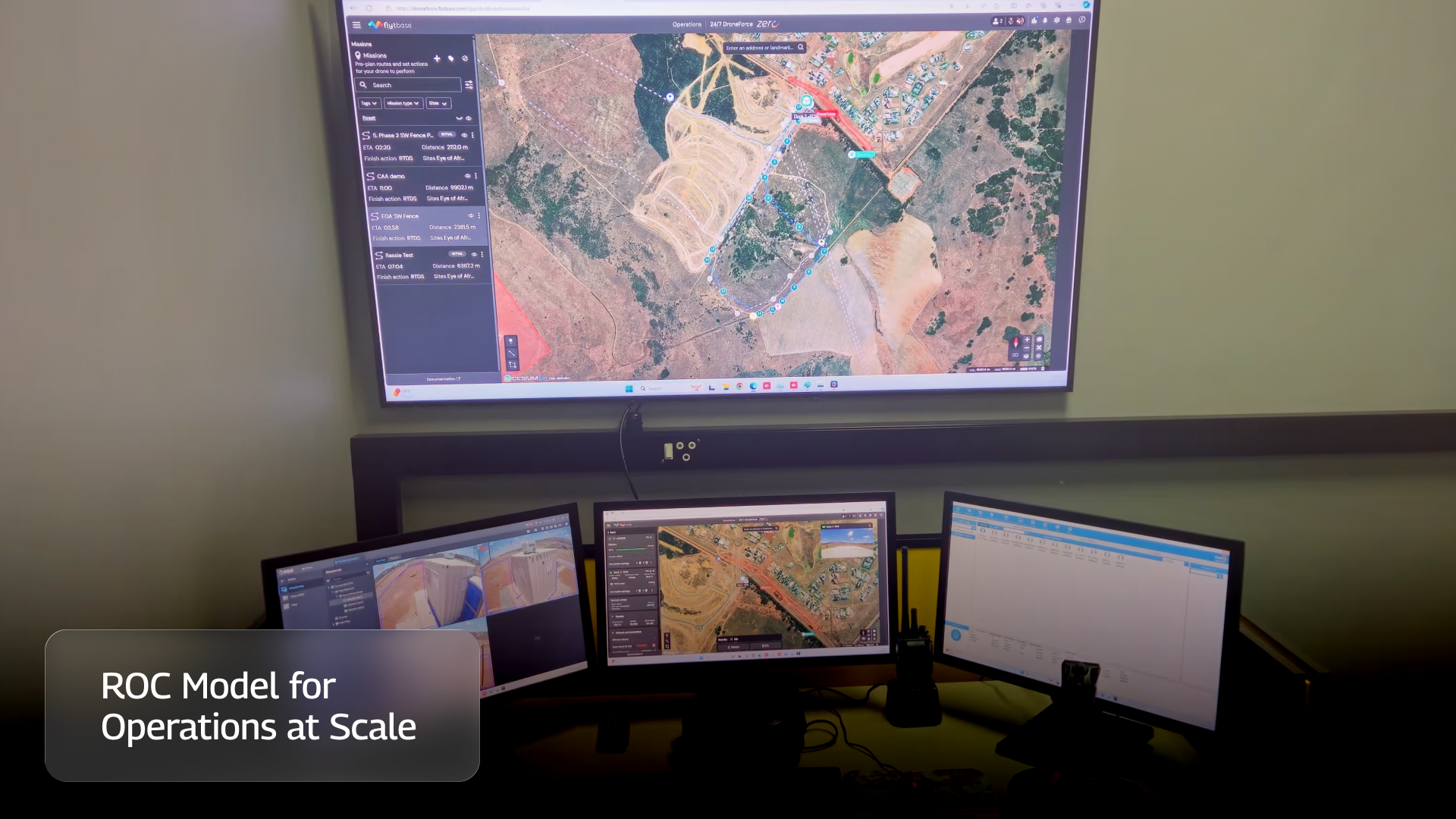
Behind the scenes, FlytBase orchestrates every operation through its Remote Operations Center (ROC) — a cloud-based command platform that enables real-time control, monitoring, and alert response across all deployed drones. This architecture not only ensures mission reliability and data security, but also allows MSS to manage multiple locations through one unified interface — a hallmark of FlytBase’s enterprise-ready, hardware-agnostic approach to autonomy.
Results: Operational Transformation and ROI
The outcomes speak to the value of autonomy done right.
- 24/7 coverage without increasing manpower.
- Incident response times reduced to seconds, not minutes.
- Safer deployment — no need for staff to patrol in hazardous zones.
- Consistent operational performance, regardless of weather or shift changes.
“Much safer, time-effective use of a resource,” said the MSS Security management team, summarizing the impact.
The success at Port Lincoln Airport became a blueprint for replication — MSS has since announced plans to expand autonomous operations to seven additional airport sites across Australia. For FlytBase, the project demonstrated the maturity of its BVLOS orchestration framework — showing that autonomy can meet the highest standards of aviation compliance and enterprise security in tandem.
For a deeper look at the deployment details, read the full MSS Security BVLOS Case Study.
The Future of Enterprise Security
The MSS Security project underscores a clear reality: the era of human-only security patrols is ending. As regulations evolve and AI-driven autonomy matures, enterprises are shifting from reactive monitoring to continuous, data-backed surveillance. BVLOS-certified operations are no longer outliers, they’re becoming the operational standard of 2025 and beyond.
By combining reliable hardware with FlytBase’s AI-powered orchestration, organizations across airports, utilities, and industrial facilities can achieve both uninterrupted security and operational efficiency at scale.
Explore Enterprise BVLOS Deployment with FlytBase and see how autonomy can protect what matters most. Schedule a Consultation.
Preguntas frecuentes
Encuentre respuestas rápidas a preguntas frecuentes sobre compatibilidad, configuración, funciones y precios
The system runs on the FlytBase Remote Operations Center (ROC) — managing three drone docks equipped with day/night cameras, AI-based threat detection, and two-way communication for live interaction and deterrence.
MSS Security’s Port Lincoln deployment was Australia’s first CASA-approved BVLOS airport security operation. It set a national precedent, proving that autonomous drones can deliver continuous 24/7 surveillance safely and within aviation regulations.
The AI engine was trained on airport-specific data to tell apart humans, wildlife, and vehicles — cutting false positives by over 80% and ensuring operators only act on verified alerts.
Yes. FlytBase’s platform is hardware-agnostic and fully scalable, meaning any enterprise — from airports to utilities — can adopt the same model with tailored workflows and regulatory support from FlytBase’s team.
.webp)
.svg)
.webp)
.png)
