





Obtenga el suyo gratis Guía de autonomía de drones ¡Hoy!

Most drone programs do not fail because the technology does not work. They fail because the system stops too early. The aircraft flies. Images are captured. Data is stored. Reports are generated. The pilot project succeeds exactly as planned. And yet months later, the program struggles to expand or deliver meaningful operational value.
Across industries, this pattern appears again and again. The issue is rarely the drone itself. The issue is that the deployment stops at observation instead of completing the full operational loop. Data is collected, but it never consistently translates into decisions or actions.
At the NestGen Retreat, conversations with enterprise operators revealed that this gap is one of the most common barriers to scaling autonomous drone programs. Organizations successfully prove that drones can collect data, but far fewer build systems that convert that data into operational outcomes.
In other words, the industry has spent years solving the problem of flight. The harder challenge is turning those flights into decisions.
The Data Trap
Over the past decade, drone technology has advanced rapidly. Aircraft are more reliable, autonomous missions are easier to schedule, and docked drones can launch and return without a pilot on site. These advances have made aerial data collection dramatically more efficient. But efficiency alone does not create operational value.
Many organizations fall into what could be called the data trap. A drone captures hundreds or thousands of images during inspections or patrols. Those images are stored, reviewed, or compiled into reports. The system produces information, but that information rarely flows directly into the workflows that drive real decisions.
When that happens, drones remain isolated tools rather than integrated operational systems. Maintenance teams still rely on manual inspection schedules. Security teams verify incidents through ground patrols. Operations managers review reports after the moment when action would have been most valuable.
The drone captures data, but the organization never fully captures the value. The problem is not the amount of imagery being collected. It is the absence of a system that translates observation into action.
Designing Programs Around Applications
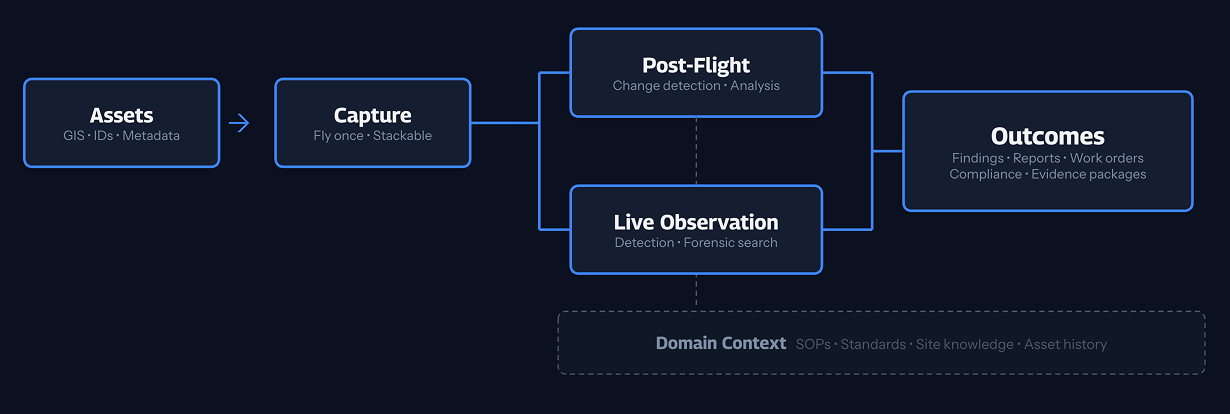
Organizations that successfully scale drone deployments approach the problem differently. Instead of beginning with the aircraft, they begin with the application. They start by defining the operational problem they want to solve. Which assets need to be monitored? What signals indicate that something has gone wrong? And what should happen when that signal appears?
Once these questions are clear, the role of the drone becomes straightforward. The aircraft is no longer the center of the system. It becomes one instrument within a larger operational workflow that captures the information needed to support a specific decision. This shift from drone-first to application-first thinking changes how autonomous systems are designed. Flights are scheduled to support operational requirements, and the data collected is immediately tied to the actions that follow.
The drone still performs the same task. But its role within the organization becomes fundamentally different.
Completing the Operational Loop
Real operational value emerges when drone systems complete what can be described as the operational loop. First comes observation. The drone captures visual or sensor data from the physical environment. Next comes interpretation. AI models or analytics tools analyze that data to detect anomalies, identify patterns, or flag events that require attention.
Then comes decision-making. The system determines whether a detected anomaly represents a real operational issue and what response should follow. Finally comes action. A maintenance inspection may be scheduled. A security team may receive an alert. In some cases, another drone may launch automatically to verify the situation.
When these stages function together, drones stop being simple data collection tools. They become part of a system that continuously observes and responds to the physical world. The difference is subtle but important. Data explains what happened. Outcomes determine what happens next.
Where Enterprise Value Actually Emerges
This distinction ultimately determines whether drone programs remain experimental or become operational infrastructure.
Enterprises managing industrial sites, logistics hubs, transportation networks, and critical infrastructure are not searching for more aerial imagery. What they need is earlier detection of problems, faster verification of incidents, and clearer visibility into the environments they manage.
Drones can play a powerful role in achieving those outcomes. But only when they are integrated into the broader systems that already govern operations. That integration connects drone observations with maintenance platforms, security systems, operational dashboards, and automated workflows. Once those connections exist, the drone becomes part of a continuous intelligence loop that monitors the physical environment and triggers action when conditions change.
At that point, the drone stops being an experimental technology. It becomes infrastructure.
Moving Beyond the Flight
The first phase of the drone industry focused on proving that autonomous flight was possible. The next phase will be defined by something more practical. Proving that autonomous systems can deliver measurable operational outcomes.
Organizations that succeed will not simply deploy drones. They will design application-driven systems where observation flows directly into decisions and actions. When that happens, drones stop collecting data. They start delivering outcomes.
Preguntas frecuentes
Encuentre respuestas rápidas a preguntas frecuentes sobre compatibilidad, configuración, funciones y precios
.webp)
.svg)
.webp)

.png)
