




Get Your Free Drone Autonomy Guide Today!

For much of the past decade, the commercial drone industry has been focused on a single question: how do we scale flights? Progress was measured in physical terms. More drones deployed. More docks installed. More sites are monitored. Companies worked to improve aircraft reliability, expand automation, and build infrastructure capable of supporting unattended operations across larger environments.
These advances were necessary. They created the technical foundation that made large scale autonomous drone deployments possible. But they represent only one dimension of what is now unfolding. A second axis of growth is beginning to emerge. One that is less about the number of drones in the air and more about the intelligence those systems generate once they are deployed.
Seen through this lens, autonomous drone networks begin to resemble something far more complex than fleets of aircraft. They are starting to form the early architecture of a nervous system for the physical world. A distributed layer capable of sensing, interpreting, and responding to events across complex environments.
At the NestGen Retreat in Jaipur, leaders working at the frontier of autonomous drone deployments gathered to discuss what this shift might mean for the next phase of the industry. Across many of the conversations, one insight kept resurfacing. The real transformation ahead will not come from scaling drones alone. It will come from connecting them into systems that can convert physical observation into operational intelligence.
The Two Axes of the Drone Industry
The early growth of the drone industry followed what could be described as the root system axis. Like the roots of a plant spreading through soil, drone deployments expanded by extending physical coverage. Organizations installed more docking stations, deployed drones across additional facilities, and expanded their ability to observe larger operational environments. This expansion created reach. It increased the surface area that could be inspected, monitored, or secured.
Infrastructure scale made autonomous operations possible. But scale alone does not determine long term value. Alongside the root system axis, a second dimension is now beginning to take shape. This is the nervous system axis. This axis is not defined by how many drones are deployed. It is defined by how intelligently the information collected by those drones is interpreted and used.
In this model, the drone itself becomes only the starting point in a larger chain of intelligence. Flights capture data from the physical world. The real value lies in what the system understands about that data and what actions it enables as a result.

Organizations that move along this axis are no longer competing primarily on aircraft performance or fleet size. They are competing on the depth of operational intelligence they can generate from the environments they monitor.
The Architecture Behind the Nervous System
To understand how this nervous system is forming, it helps to step back from the drone itself and look at the broader systems now developing around it.
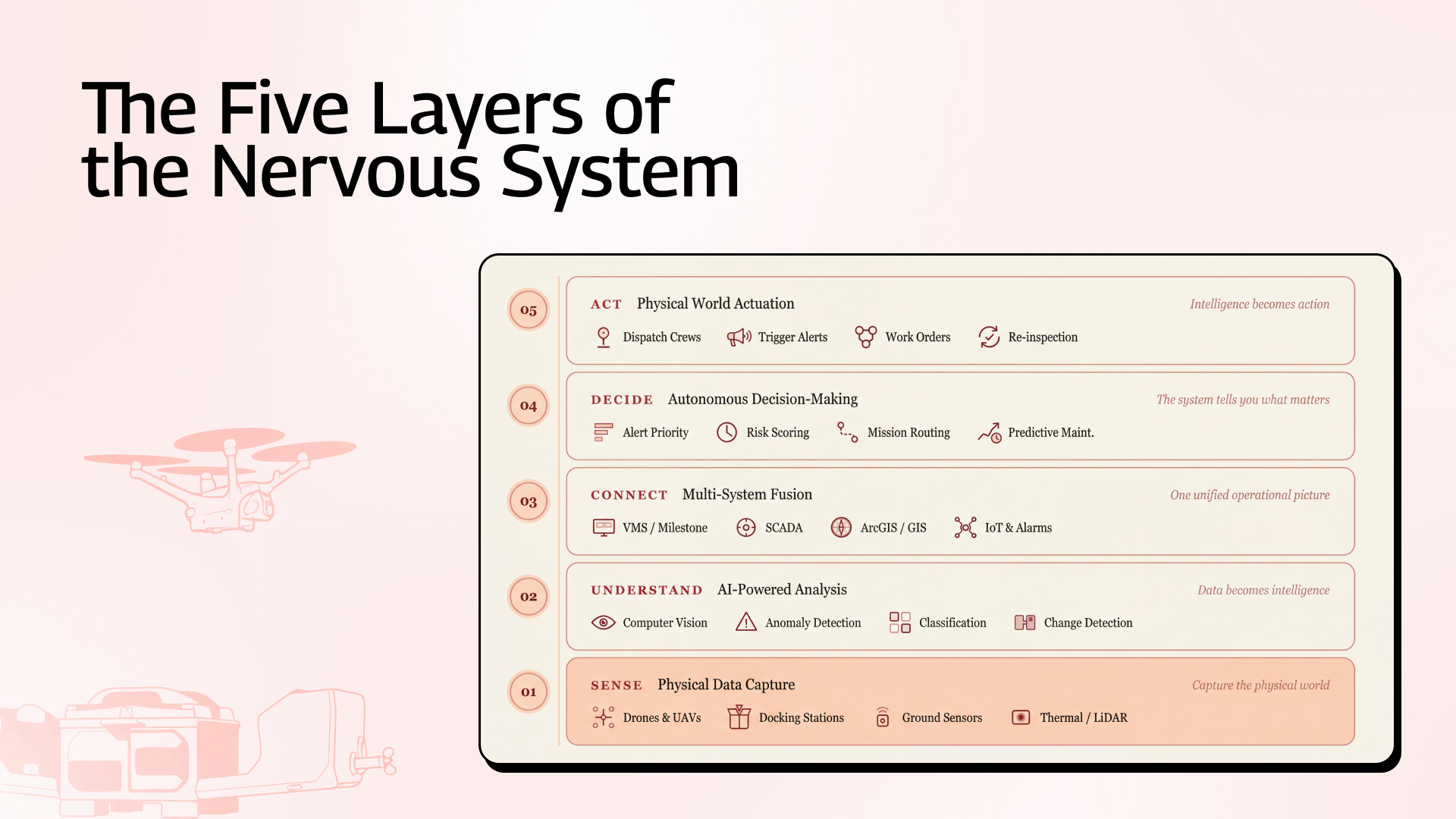
Across many deployments, a similar structure is beginning to emerge. Drones capture data from the physical world while AI systems analyze that data in near real time. Information from multiple sensing technologies then converges into a unified operational view, combining drone imagery with CCTV networks, alarms, maintenance systems, and other enterprise tools.
As these systems become more connected, software increasingly determines which signals matter and what actions should follow. A drone may be dispatched automatically to verify an anomaly. A maintenance team may receive a task based on detected equipment issues. A security workflow may trigger in response to a perimeter breach.
What emerges is a continuous loop between sensing, interpretation, and response. In effect, the infrastructure itself begins to behave like a nervous system.
Why This Shift Matters
Thinking about drone deployments as part of a nervous system reveals an important shift in how the industry creates value. Companies that grow primarily along the root system axis expand their business by deploying more infrastructure. Revenue increases through additional sites, additional docks, and larger fleets.
Companies that grow along the nervous system axis deepen the intelligence delivered within each deployment. Instead of selling drone flights, they begin delivering something more valuable. Operational intelligence about the environments their customers manage.
This shift changes what organizations ultimately care about. Very few companies deploy drones simply because they want drones. What they want are the outcomes that improved situational awareness makes possible. Earlier detection of equipment failures. Faster incident response. Safer operations. Better visibility across complex infrastructure.
Once the conversation moves from aircraft to outcomes, the competitive landscape changes as well. The value of the system becomes less about the drone itself and more about the intelligence layer built around it.
It also introduces a new challenge for the industry. As organizations deploy autonomous drones across multiple sites, the question is no longer whether the technology works. The question becomes how these systems integrate into existing operational workflows and decision making processes.
In other words, the challenge is no longer aviation. It is systems design.
Toward an Intelligent Physical World
Seen through this lens, autonomous drones represent something larger than a new generation of aerial robotics. They are helping form the early architecture of an intelligent physical world.
Sensors observe what is happening across complex environments. Software systems interpret those signals. Operational workflows trigger responses when anomalies appear. The result is infrastructure that becomes observable, interpretable, and increasingly responsive. The drone industry began by solving the problem of flight.
The next decade will be defined by something more ambitious. It will be defined by the systems that connect those flights together and transform fleets of autonomous machines into the nervous system of the physical world.
FAQs
Find quick answers to common questions about compatibility, setup, features, and pricing
.webp)
.svg)
.webp)

.png)
