
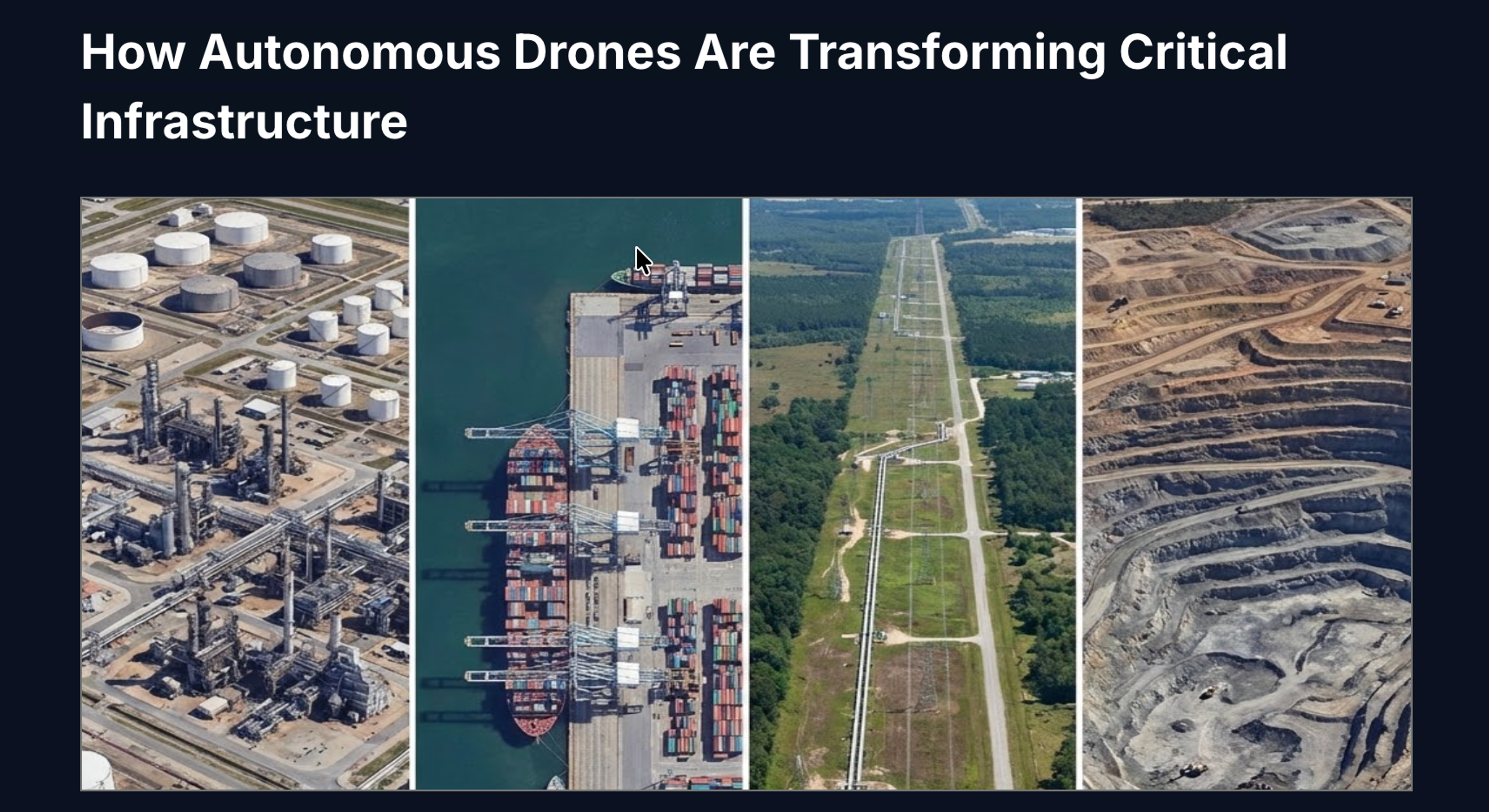
Across industries that manage large physical assets, a quiet shift is underway. For years, drones were introduced as tools for occasional inspections or aerial surveys. Teams would deploy a pilot, fly a mission, capture imagery, and analyze the results later.
Today, that model is evolving.
Autonomous drones are beginning to operate as persistent infrastructure systems. Instead of occasional flights, organizations are deploying docked drones that can launch automatically, perform routine missions, and return without human intervention. The result is a new operational capability: continuous visibility across complex infrastructure environments.
From energy facilities and mining operations to rail networks and emergency response programs, autonomous drones are moving from experimental technology to operational systems that help organizations monitor and manage critical infrastructure.
Energy, Utilities, and Mining: Automating Inspection at Scale
Energy and utility companies operate some of the most complex and geographically distributed infrastructure in the world. Power plants, pipelines, solar farms, and transmission networks all require frequent inspection to maintain safety and reliability.
Traditionally, these inspections required sending workers into hazardous environments or dispatching drone pilots to capture imagery.
Autonomous drone systems are beginning to change that process. At energy facilities, docked drones can now perform scheduled inspection missions around plants and equipment. A drone can automatically launch from its docking station, follow a predefined inspection route, capture thermal or visual data, and return to recharge. This process allows organizations to inspect equipment more frequently while reducing the need for personnel to enter high-risk areas.
Utilities are adopting similar approaches for infrastructure monitoring. Hydropower operators, for example, are using autonomous drones to inspect remote dam facilities where manual inspections are difficult or time-consuming.
In mining environments, drones can survey pits, monitor site conditions, and collect mapping data without placing survey teams in potentially dangerous locations. Automated flights allow companies to track changes across large sites on a daily or weekly basis.
In each case, the value comes from consistency. Autonomous drones can perform inspections repeatedly, at defined intervals, generating data that helps operators detect problems earlier.
Security and Public Safety: Eyes in the Sky
Another area where autonomous drone deployments are gaining momentum is security. Large industrial sites, warehouses, and data centers often require constant perimeter monitoring. Traditionally, this work relied on guard patrols or fixed cameras with limited coverage. Autonomous drones provide a different capability.
Drones stationed in docking systems can launch automatically when an alarm is triggered or perform routine patrol flights around facilities. Live video streams are sent directly to security operations centers, allowing teams to quickly verify incidents and determine whether a response is required.
In some deployments, drones have even helped prevent high-value theft by identifying suspicious activity early and alerting security teams in real time.
Public safety agencies are exploring similar capabilities through programs known as drones as first responders.
In these systems, drones are positioned at strategic locations across a city or region. When an emergency call or alarm is received, a drone can launch automatically and fly to the incident location. By the time police officers or firefighters arrive, the drone is already streaming live aerial footage to the command center, improving situational awareness and helping responders prepare for the scene.
This ability to reach incidents quickly and provide immediate visual context is one of the reasons autonomous drones are attracting attention from emergency services worldwide.
Railroads, Ports, and Transportation Networks
Transportation infrastructure presents another compelling use case for autonomous drones. Rail operators must monitor thousands of miles of track and infrastructure to detect potential risks. Bridges, crossings, and rail corridors require regular inspection to maintain safety.
Autonomous drones allow operators to monitor these assets more frequently and with greater coverage. Instead of sending teams to inspect sections of track manually, scheduled drone missions can capture imagery along rail corridors and identify potential issues before they escalate.
Ports and logistics hubs face similar challenges. These environments are large, dynamic, and often operate around the clock. Autonomous drones can help monitor equipment, inspect facilities, and provide aerial oversight across complex operations.
Because drones can move quickly through large areas, they offer visibility that is difficult to achieve with fixed cameras or ground patrols alone.
From Individual Flights to Infrastructure Systems
What connects these deployments across industries is not just the drone itself. It is the shift from individual flights to integrated operational systems.
Autonomous drone deployments combine docking infrastructure, fleet management software, remote operations centers, and analytics tools. Together, these components allow organizations to run drone operations continuously across multiple locations.
Instead of scheduling occasional missions, companies can create monitoring systems that operate every day. This shift is especially important for industries responsible for critical infrastructure. These organizations manage environments where downtime, safety risks, or security incidents can have significant consequences.
Autonomous drones provide a way to observe these environments more consistently and respond more quickly when conditions change.
The Next Phase of Infrastructure Monitoring
The examples emerging across energy, utilities, security, public safety, and transportation illustrate a broader trend. Autonomous drones are no longer limited to pilot projects. They are becoming part of the operational infrastructure used to monitor and manage the physical world.
As deployments scale and integration with enterprise systems improves, drones will increasingly function as persistent sensing systems embedded within industrial environments. For organizations responsible for critical infrastructure, the question is no longer whether drones can collect aerial data. It is how autonomous systems can be integrated into daily operations to provide faster insights, safer inspections, and better visibility across the assets that keep modern society running.