

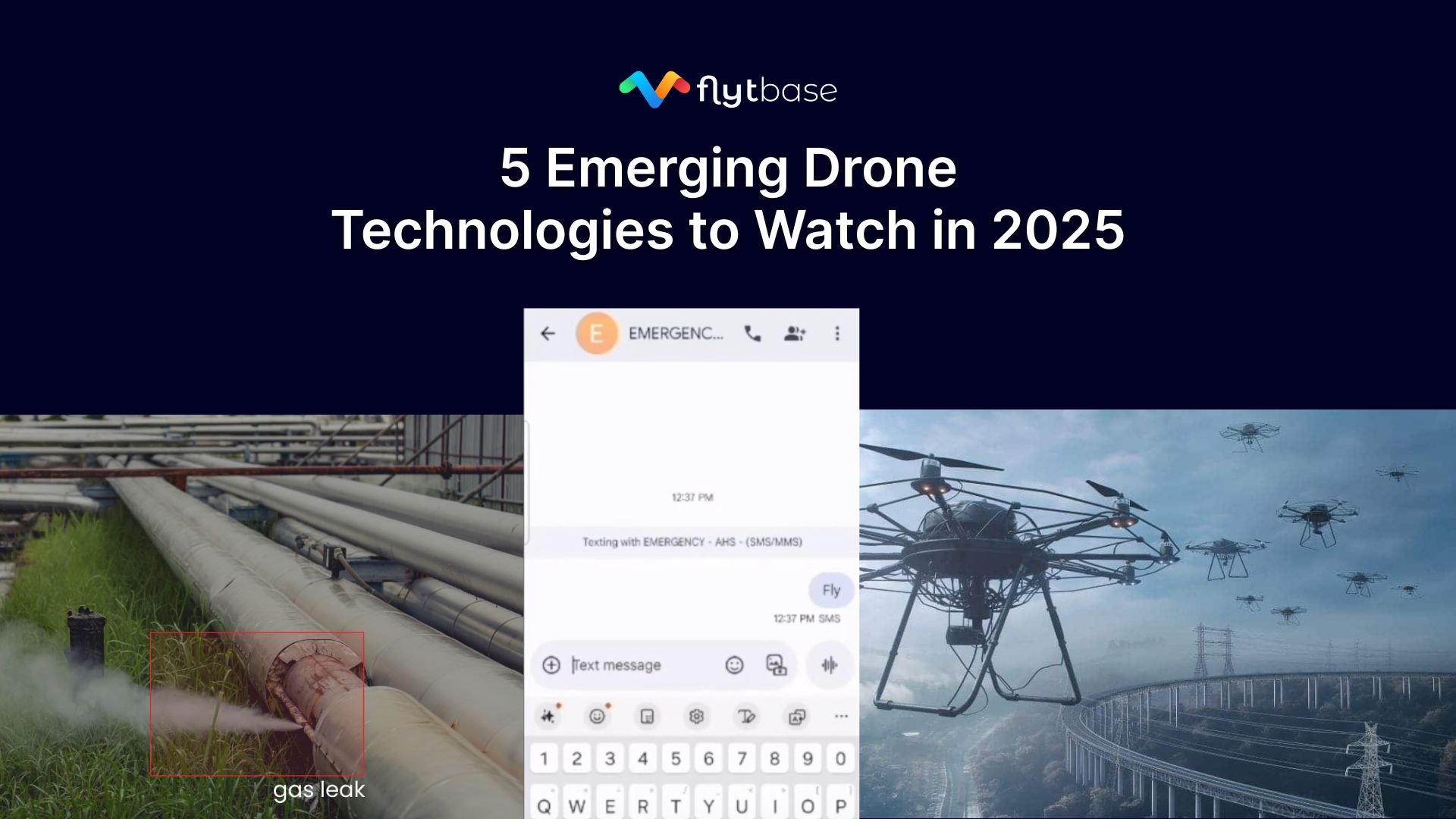
The drone industry continues to evolve rapidly as technology enables new levels of autonomy, reliability, and scalability. In 2025, several innovations will redefine how enterprises deploy and manage autonomous systems across industries such as energy, mining, logistics, and infrastructure management.
This article highlights five technologies that are transforming drone operations from manual and reactive to intelligent and predictive systems.
1. Swarm Intelligence
Industrial sites increasingly require simultaneous inspection, monitoring, and data collection across large areas. Swarm intelligence allows multiple drones to coordinate autonomously as a unified fleet.
Each drone communicates with others, shares data, and adjusts its flight path in real time. If one drone encounters a technical issue, another automatically takes over the task. This approach increases coverage efficiency, reduces downtime, and improves overall safety.
FlytBase orchestration technology already supports multi-vehicle autonomy, enabling organizations to manage entire fleets through a single control platform while maintaining centralized oversight and operational consistency.
2. Edge Artificial Intelligence
Cloud processing provides scalability but introduces latency. Edge artificial intelligence resolves this by processing data where it is collected, either on the drone or within local infrastructure.
Edge processing reduces dependence on continuous connectivity and enables immediate operational decisions. Drones equipped with edge AI can detect anomalies, temperature variations, or safety hazards and trigger automated responses without waiting for cloud analysis.
This capability lowers data transmission costs, improves real-time responsiveness, and ensures reliability in remote or bandwidth-constrained environments.
3. Multi-Spectral and Hyperspectral Imaging
Standard cameras capture visible imagery, but many operational challenges require deeper analysis. Multi-spectral and hyperspectral sensors capture light across multiple wavelengths, providing insights into chemical composition, material conditions, and environmental changes.
This data enables early detection of gas leaks, corrosion, soil degradation, and crop stress. When combined with AI-based analytics, drones become diagnostic tools capable of identifying structural and environmental risks before they escalate.
FlytBase integrates advanced sensor data into unified analytics dashboards, allowing enterprises to convert these insights into timely maintenance and compliance actions.
4. All-Weather Autonomy
Adverse weather has traditionally limited drone operations. Recent hardware and control system advances have made all-weather operations achievable.
Modern drones now include anti-icing systems, sealed components for dust and water resistance, and stabilization algorithms that maintain flight control in strong winds. These improvements allow drones to continue operations during rain, heat, or snow, reducing delays caused by environmental conditions.
Organizations using FlytBase orchestration technology have already deployed all-weather drones for offshore, mining, and arctic operations, achieving uninterrupted monitoring and inspection throughout the year.
5. Interactive and Bidirectional Drones
Next-generation drones are no longer limited to observation. They are increasingly capable of performing physical tasks through robotic attachments and manipulators.
This capability enables remote valve operation, sample collection, medical supply delivery, and temporary communication restoration during emergencies. Interactive drones close the gap between detection and intervention, expanding the role of autonomous systems in active maintenance and disaster response.
Building the Competitive Advantage
Each of these technologies addresses long-standing barriers to scale, latency, and environmental reliability. Together, they enable enterprises to move from reactive monitoring to predictive and autonomous operations.
Organizations that invest early in these capabilities will benefit from improved safety, reduced operational costs, and faster decision-making. The FlytBase orchestration platform integrates these advancements into a unified ecosystem that supports scalable, data-driven autonomy.
To learn how FlytBase enables enterprise-scale autonomous operations, contact us for a product demonstration.