.avif)


Get Your Free Drone Autonomy Guide Today!

Every industrial operation has safety protocols. Every facility has inspection schedules. Yet, across refineries, mines, and utility sites, one quiet truth remains: people still walk into risk zones every day to collect data that drones could capture automatically.
Despite billions spent on safety programs, inspections continue to expose workers to hazardous environments — confined spaces, extreme temperatures, unstable terrain, and heavy machinery. The systems designed to protect them depend on the same manual workflows that have existed for decades.
When inspections depend on human reach
At Shell Petroleum’s large-scale operations, visual inspections of flare stacks once required maintenance crews to climb tall structures under intense heat. The process demanded extended setup times, additional safety supervision, and significant downtime. While procedures were followed to the letter, the risk of fatigue and human error could never be fully eliminated.
In the mining sector, Anglo American’s Quellaveco site in Peru faced similar challenges. Teams spent hours navigating steep terrain and high-altitude conditions for equipment checks. Even short delays — caused by weather or limited visibility — meant production slowdowns and repeated travel across difficult routes.
Every one of these missions achieved its immediate purpose: compliance. But they also carried an unseen cost — exposure.
The limits of “safe enough”
Many enterprises believe that strict PPE protocols and frequent safety audits mean inspections are safe. In reality, manual processes hide operational inefficiencies that can put teams and timelines at risk.
Key factors include:
- Fatigue and repetition: Repeated manual checks increase the likelihood of small oversights.
- Time gaps: Inspections performed weekly or monthly miss gradual changes between intervals.
- Data inconsistency: Visual notes and photos depend on the inspector’s perspective, not objective measurement.
- Exposure risk: Even with precautions, every on-site entry adds potential liability.
Across multiple FlytBase customers in energy and mining, the shift from manual to autonomous inspections revealed a measurable difference — fewer hours of exposure, more consistent data, and faster maintenance turnaround times.
How autonomous systems redefine safety
Safety improves when people step back from danger zones entirely. With docked drones powered by the FlytBase platform, inspections can now be scheduled, executed, and reviewed without any human presence on-site.
The process looks different — and that’s the point.
- Drones launch automatically from secure docks at set intervals or in response to pre-programmed triggers.
- Each flight captures high-resolution and thermal imagery, providing an exact digital record of site conditions.
- The FlytBase platform uploads and organizes this data in real time, allowing teams to compare new visuals with historical benchmarks.
At Shell, automated missions reduced inspection duration from several hours to under thirty minutes. At Anglo American, teams achieved a 90% reduction in on-site travel time while maintaining full safety and compliance standards.
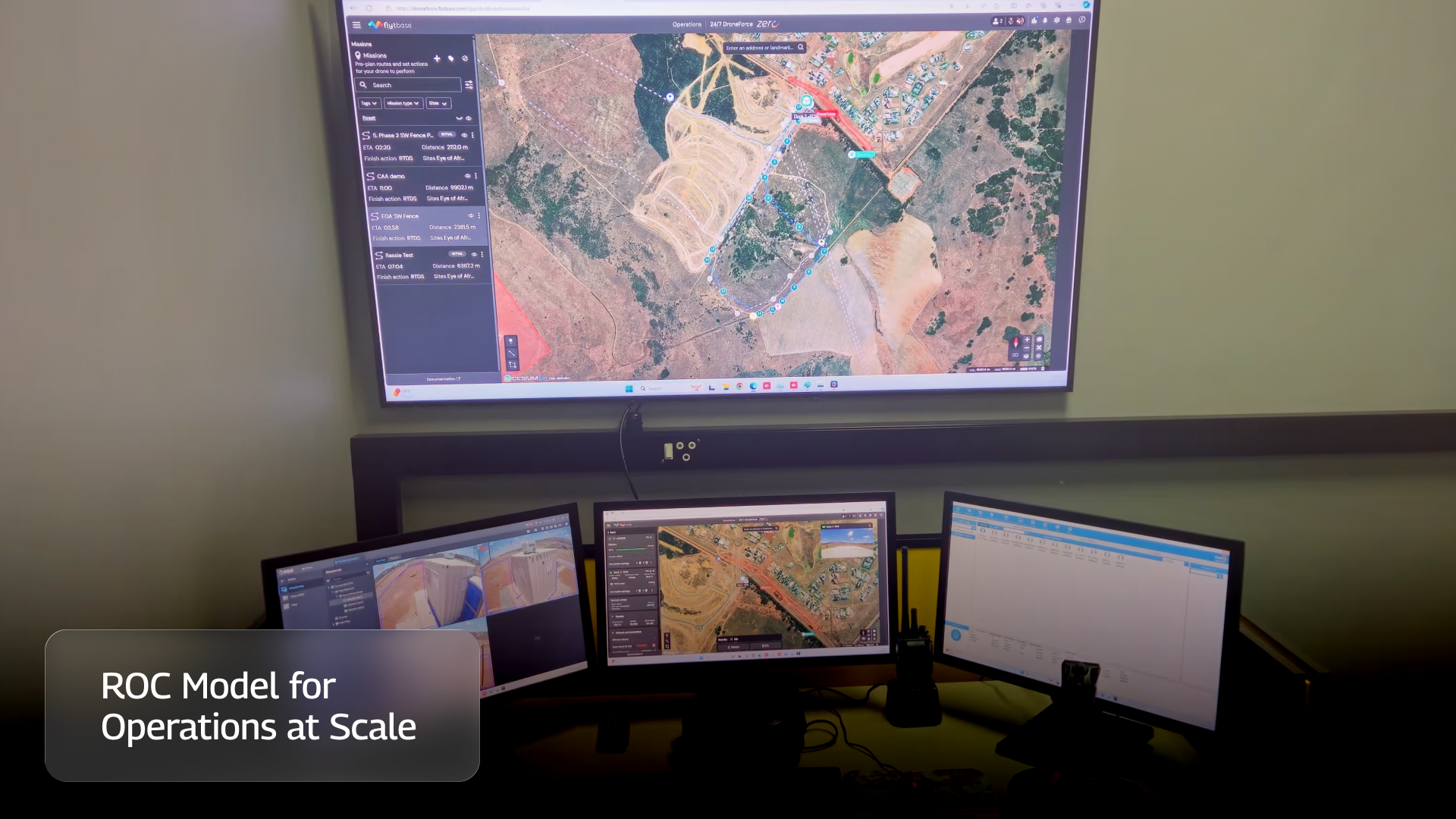
What once required ladders, scaffolds, and long-distance climbs now takes place entirely within controlled command centers — a complete transformation in how risk is managed.
From compliance to prevention
Automated inspections deliver more than safety; they build predictability. With consistent, machine-captured data, teams can identify small anomalies such as cracks, leaks, or temperature variations long before they escalate into incidents.
That visibility enables a shift from reactive maintenance to predictive safety, where decisions are guided by continuous, verifiable evidence. In practice, this means fewer unplanned shutdowns, lower maintenance costs, and a stronger foundation for ESG reporting — all without putting a single person in harm’s way.
The new definition of safety
True safety in 2025 is not about how well humans operate within risk zones, but how effectively we can remove them from those zones altogether. By combining docked drone systems with FlytBase’s autonomous inspection platform, enterprises are replacing uncertainty with structured intelligence. What was once an unavoidable hazard is now a fully automated process — safer, faster, and far more accurate.
To see how enterprises like Shell and Anglo American have scaled their inspection programs through automation, explore the FlytBase Case Study Library.
FAQs
Find quick answers to common questions about compatibility, setup, features, and pricing
Most inspections require people to physically access high, confined, or hot areas — such as flare stacks, tanks, or mine sites. Even with strict safety protocols, exposure to height, heat, or hazardous materials creates unavoidable risk.
Autonomous drones eliminate the need for workers to enter dangerous zones. With FlytBase, drones are docked on-site and execute scheduled or on-demand inspection missions automatically, capturing high-resolution visuals and thermal data while operators stay in control rooms.
Yes. Every FlytBase mission generates a structured, timestamped record of flight paths, images, and reports. This digital audit trail supports compliance with industry standards while reducing the burden of manual documentation.
Yes. Every FlytBase mission generates a structured, timestamped record of flight paths, images, and reports. This digital audit trail supports compliance with industry standards while reducing the burden of manual documentation.
.webp)
.svg)
.webp)
.png)
