.avif)


Get Your Free Drone Autonomy Guide Today!

Autonomous drone security only becomes economically viable when one operator can manage multiple sites at the same time. If every drone deployment requires a dedicated pilot, labor costs scale linearly and erase most of the benefits drones promise.
This article breaks down how Titan Protection's Remote Operations Center (ROC) enables a single pilot to oversee autonomous drone operations across multiple states simultaneously. It explains what the FAA actually approved to make this possible, why infrastructure matters more than aircraft, and how automation and edge intelligence reduce human workload without compromising safety.
This is not a future concept. It is how large-scale drone security operates today.
One-to-Many Operations Are the Real Economic Breakthrough
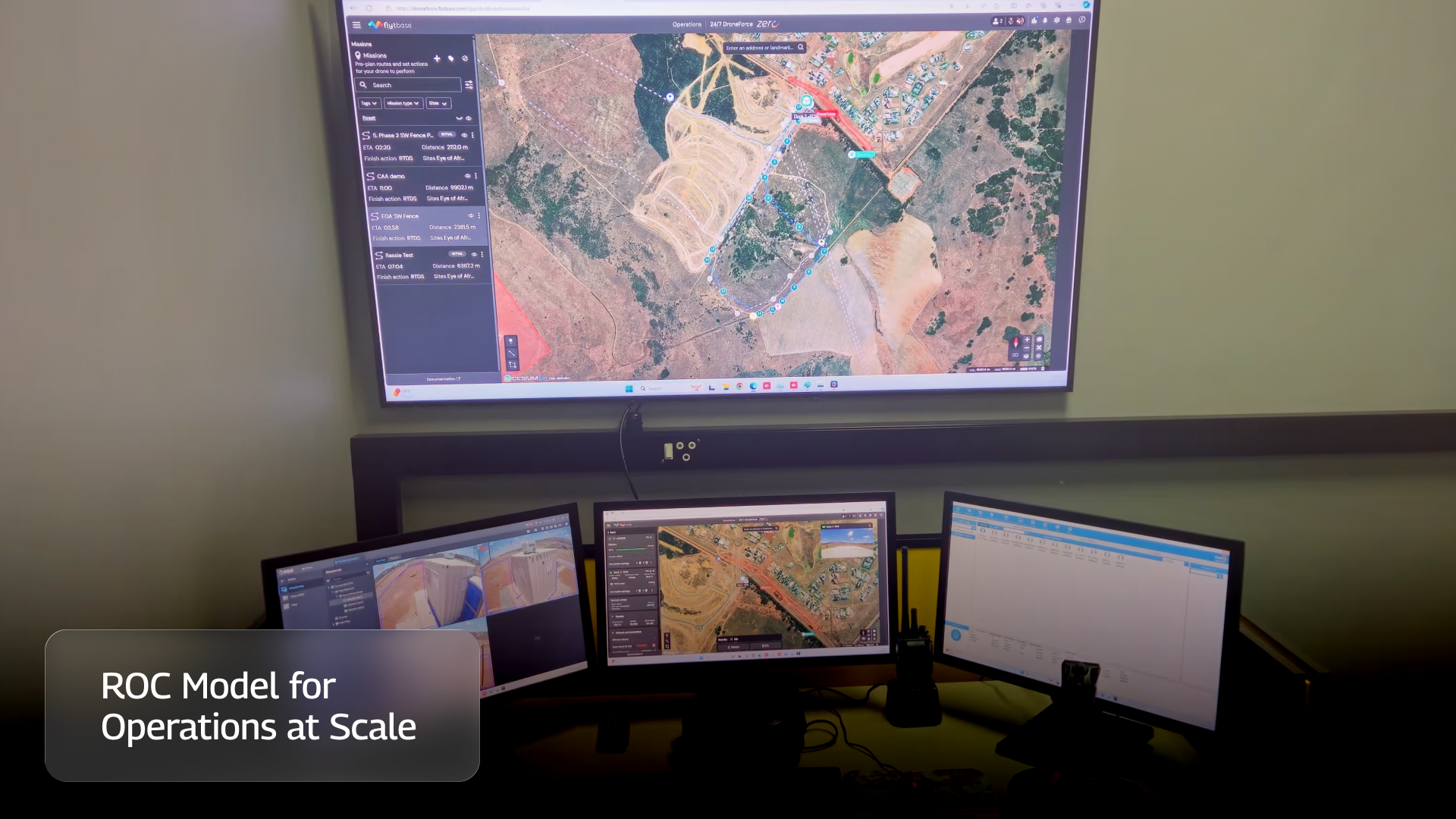
Titan Protection operates a Remote Operations Center in Kansas City that manages autonomous drone launches at sites in Texas, Oklahoma, and several other states. From one monitoring station, a single pilot can oversee multiple active deployments at the same time.
That capability fundamentally changes the cost structure of drone security.
If drone security required one dedicated pilot per site, the economics would look familiar. A remote pilot costs roughly $50,000–$70,000 per year. A traditional security officer costs a similar amount. In that model, you are simply swapping one labor role for another without changing how costs scale.
One-to-many operations break that ceiling. With the right approvals and infrastructure, Titan staffs two to three pilots to manage ten or more sites across shifts. Instead of labor scaling linearly with each new deployment, costs are shared across sites. That is the point where drone security stops being a premium experiment and becomes a viable alternative to traditional coverage.
The limiting factor was never the drone. It was the ability to operate safely and legally at scale.
What the FAA Actually Approved
Titan was the first security company to receive a nationwide Beyond Visual Line of Sight (BVLOS) waiver. The approval did not focus on a specific aircraft or docking station.
The FAA approved a system. That system includes pilot qualifications, training programs, operational procedures, safety management processes, and the Remote Operations Center itself. The waiver exists because the FAA determined that Titan could manage complexity, risk, and decision-making across multiple sites without degrading safety.
This distinction matters. One-to-many operations are not about flying drones remotely like toys. They are about proving that a centralized operation can maintain situational awareness across weather, airspace, system health, and active missions at the same time.
Without that proof, one-to-many operations do not get approved.
Inside the Remote Operations Center
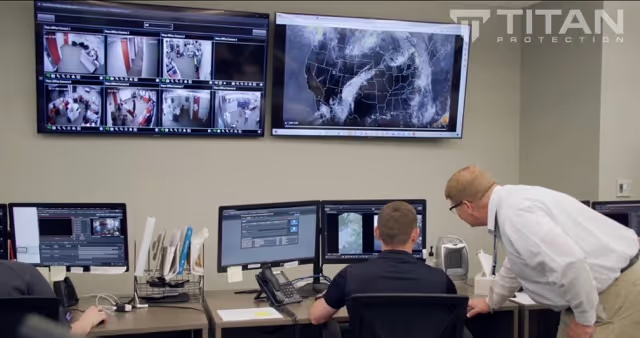
Titan's ROC is UL-listed and Five Diamond certified, meeting the same standards as high-security monitoring centers. It operates 24/7 with staffed shifts and documented procedures.
From a single console, pilots monitor multiple inputs across all deployed sites:
- Weather conditions and forecast windows
- Airspace restrictions and advisories
- Drone health, battery levels, and connectivity
- Alarm system integrations and live alerts
- Active and scheduled missions across locations
This is not manual flying. It is system oversight. When an alarm triggers at a car dealership in Texas while a scheduled patrol is running at a construction site in Oklahoma, the pilot evaluates both situations, prioritizes response, and manages launches through a centralized control layer. The work looks far closer to air traffic control than traditional security monitoring.
How One Pilot Prioritizes Multiple Sites
Consider a real-world scenario.
At 2:15 a.m., Site A triggers a perimeter alert. Thermal detection indicates a vehicle entering the property. A drone launch is queued.
At 2:16 a.m., Site B triggers motion near a fence line 800 miles away. The signal is ambiguous.
The pilot launches the drone at Site A immediately and continues monitoring Site B. If the second alert escalates, the next launch follows. If it resolves as an animal or environmental noise, the alert is cleared without a flight.
These decisions happen in seconds. This is what one-to-many operations demand. The pilot is not reacting to alarms blindly. They are assessing relative risk across sites, allocating attention, managing system resources, and coordinating response teams when necessary.
Why Automation and Edge Intelligence Make This Possible
Without automation, one-to-many operations would collapse under human workload.
Edge intelligence running at the docking station filters raw sensor data before it ever reaches the pilot. False positives from animals, weather, or vegetation movement are cleared automatically. Only verified events involving people or vehicles escalate to human review.
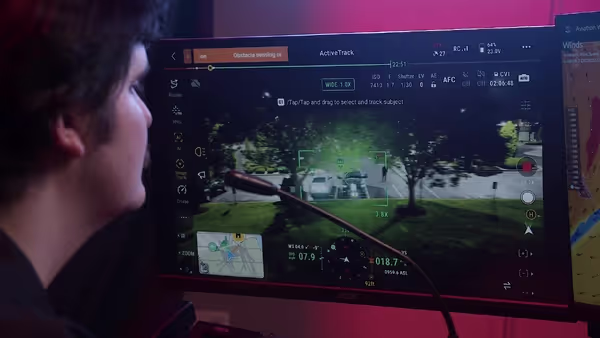
Autonomous mission execution further reduces manual intervention. Scheduled patrols launch without pilot initiation at some sites. The pilot monitors outcomes rather than approving every flight.
This filtering is not about removing humans from the loop. It is about preserving human attention for decisions that matter.
The Human Limits of One-to-Many Operations
Titan is learning these limits through live operations. Today, one pilot can effectively manage four to six active sites during an eight-hour shift. During low-activity windows, that number can increase. During high-alarm periods, it decreases.
The constraint is cognitive load, not system capacity. Launching a drone at one site while monitoring another active flight and coordinating with ground response at a third site pushes the limits of human attention. Titan builds these realities into staffing models and shift planning to maintain quality.
As automation improves, that ratio may increase. But operational discipline matters more than theoretical limits.
Why This Changes Security Company Economics
Before one-to-many operations, Titan's drone deployments scaled linearly with staffing. Growth meant hiring more pilots, which capped expansion and limited deployments to high-value sites.
With a shared Remote Operations Center, that curve changes. Adding a new site increases load marginally rather than proportionally. Costs drop as density increases.
The ROC functions like shared infrastructure. Build it once. Operate it continuously. Amortize it across every deployment. This is fundamentally different from traditional security models, where each site requires its own labor footprint.
Why Most Security Companies Cannot Replicate This
The barrier to one-to-many operations is not hardware.
It is regulatory approval, operational maturity, training programs, and capital investment. Building a UL-listed, Five Diamond certified ROC requires significant upfront cost before a single drone generates revenue.
Titan spent years progressing from manual flights to single-site BVLOS operations, then to multi-site and nationwide coverage. The FAA does not approve shortcuts.
Companies that succeed in drone security either build this infrastructure themselves or partner with organizations that already have it.

One-to-Many Is Not the Future. It Is the Requirement.
Drone security does not fail because the technology is immature. It fails when operations are designed to scale people instead of systems.
One-to-many remote operations prove that autonomous security only works when infrastructure, regulation, and human decision-making are treated as a single operating model. Drones extend reach. Automation protects attention. Centralized control prevents costs from scaling linearly.
Security teams evaluating autonomous drones should ask a harder question than "what hardware should we buy?" The real question is whether their operating model can support one pilot making safe, timely decisions across multiple sites.
That is the difference between a pilot program and a scalable security operation.
Explore how FlytBase enables remote operations centers to orchestrate multi-site drone deployments, reduce pilot workload, and make one-to-many operations operationally viable at scale.
FAQs
Find quick answers to common questions about compatibility, setup, features, and pricing
One pilot can manage drones across multiple states by operating from a centralized Remote Operations Center. Automation, edge intelligence, and FAA-approved procedures filter alerts, prioritize threats, and allow pilots to oversee multiple autonomous missions without manually flying each drone.
A Remote Operations Center is a centralized facility where trained pilots monitor airspace, weather, system health, alarms, and active drone missions across multiple sites. In drone security, the ROC functions like air traffic control, enabling safe, coordinated, multi-site operations.
If each drone site requires a dedicated pilot, labor costs scale linearly and limit adoption. One-to-many operations allow multiple sites to share pilot resources, reducing per-site costs and making autonomous drone security economically viable at scale.
The FAA approved the entire operating system, not just the drone. This includes pilot training, safety management systems, operational procedures, and the Remote Operations Center. Approval is based on the ability to manage risk and complexity across multiple sites safely.
In live operations today, one pilot can typically manage four to six active sites during a shift. The limit is cognitive load, not technology. Automation and edge intelligence help filter events, allowing pilots to focus only on verified threats.
.webp)
.svg)
.webp)
.png)
