

Get Your Free Drone Autonomy Guide Today!

In Chile and Peru, where guard salaries have risen nearly 30% in the past five years, mining companies are struggling to contain spiraling security costs. Large, remote sites often spend millions each year on guard rotations, transport, housing, and insurance. Despite these expenses, coverage gaps remain and incident response is slow, leaving mines exposed to theft and safety risks.
Today, leading operators are cutting those costs by half through the deployment of autonomous drones. By reducing ground teams from more than ten guards to just five while simultaneously expanding coverage and reducing incident response times from fifteen minutes to less than two, companies such as Anglo American, and other huge mining enterprises are showing that drones are not experimental; they are operational, at scale, across Latin America.
The High Cost of Guard-Heavy Security in LATAM Mining
Traditional mine security is labor-intensive and increasingly unsustainable. Remote operations require large guard teams, often housed on-site with the additional burden of transport, meals, and insurance. Even with ten or more guards on rotation, patrols remain slow and limited in reach, leaving critical areas unmonitored. Workers face risks during night shifts, in extreme weather, or while moving around heavy equipment.
This guard-heavy model scales costs but not efficiency. For operators competing in global commodity markets, such a structure erodes margins and undermines resilience.
How Do Autonomous Drones Reduce Security Costs?
Autonomous drones offer a fundamentally different model: one that is consistent, scalable, and cost-effective. Docked at strategic points across a site, drones can launch automatically for scheduled perimeter patrols or be dispatched instantly when an alarm is triggered.
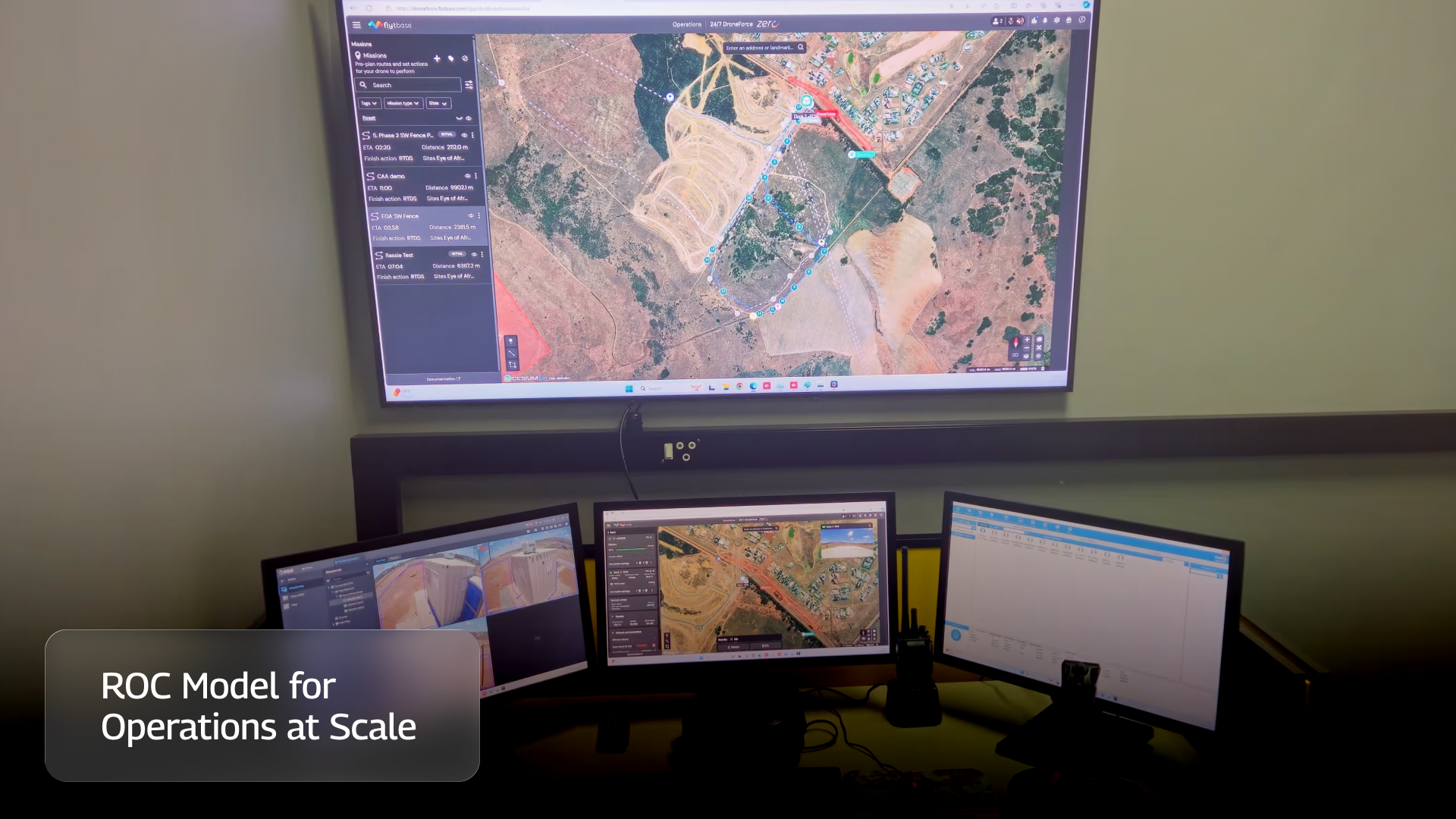
With FlytBase, these operations are overseen from centralized Remote Operations Centers (ROCs), where a leaner security team manages multiple sites simultaneously. Instead of sending guards into hazardous or distant terrain, operators receive real-time aerial visibility within seconds. This allows human guards to focus on interventions rather than repetitive patrols, improving both efficiency and safety.
Proof from Mining Leaders in Chile and Peru
This transformation is already visible across Latin America. Anglo American have scaled autonomous drone programs in Chile and Peru, while some other enterprises are leveraging FlytBase for inspection workflows that increasingly extend into security. Local partners such as UAV Latam, Runco and Drone Store Chile are supporting these deployments, helping operators move from trials to ongoing operations.
For mining leaders in the region, this provides critical validation: the largest players are proving that drones reduce labor dependency, enhance resilience, and deliver results in real-world conditions.
ROI That Goes Beyond Labor Savings
Cutting a security team from ten guards to five immediately halves payroll expenses, but the financial impact runs deeper. Mines adopting autonomous drones consistently report faster alarm verification, with drones reaching an incident in under two minutes compared to more than fifteen for a ground patrol. This speed not only prevents escalation but also reduces potential losses.
Coverage also expands dramatically, with drones patrolling areas that are too dangerous or impractical for guards on foot. Each flight produces a digital audit trail, strengthening compliance and supporting investigations. Lower incident rates, in turn, reduce insurance claims and premiums. Most importantly, guards spend less time exposed to hazards, leading to fewer workplace safety incidents and improved workforce morale.
Why Mining Operators in LATAM Choose FlytBase
FlytBase brings enterprise-grade autonomy at scale, with a focus on reliability and security. The platform is SOC 2, ISO 27001, and GDPR compliant, ensuring data remains protected under strict standards. Its hardware-agnostic design means operators can use both DJI Dock and third-party docking systems, offering flexibility to match different site requirements.
With the AI-R Edge module, drone video is processed locally, enabling instant anomaly detection while reducing bandwidth costs by up to five times. Through Flinks integrations, FlytBase drones connect directly to SCADA, VMS, and alarm systems, embedding seamlessly into existing workflows rather than operating in isolation.
Looking Ahead: The Future of Mining Security in LATAM
Mining in Latin America is at an inflection point. Rising labor costs and increasing site risks mean that traditional guard-heavy security is no longer sustainable. Autonomous drones provide a proven alternative: leaner teams, broader coverage, faster response, and lower costs.
The future of mining security is not about replacing people but about empowering smaller teams with smarter, autonomous systems. With FlytBase, that future is already operational in Chile, Peru, and beyond.
Want to see how your mine can cut security costs by 50% while strengthening resilience?
FAQs
Find quick answers to common questions about compatibility, setup, features, and pricing
Mining companies in Chile and Peru are cutting security costs by up to 50% by replacing large guard teams with autonomous drones. Instead of relying on ten or more guards, mines can operate effectively with five supported by drones that patrol perimeters, verify alarms, and stream video in real time.
Drones can verify alarms in less than two minutes, while ground patrols often take 15 minutes or longer. This faster response helps prevent theft, trespassing, and safety incidents across large mining sites.
Yes. Drones are docked at strategic points across a site and can launch automatically on schedule or when an alarm is triggered. With centralized monitoring, mines get consistent coverage around the clock without depending on guard availability.
No. Drones reduce the need for large patrol teams, but guards remain essential for on-ground interventions. The model shifts from “guards everywhere” to “smaller teams backed by drones that never miss a patrol.”
.webp)
.svg)
.webp)
.png)
