

Get Your Free Drone Autonomy Guide Today!

Security teams across airports, estates, refineries, and public safety are no longer adding more devices. They are rebuilding around one connected architecture because the pace of incidents has outgrown the systems meant to detect, verify, and respond to them.
The pattern is identical across industries: adding more hardware has not fixed the core issue. Connecting what already exists does.
Every sensor, camera, and drone plays a role. But when each operates alone, teams end up with delays, blind spots, and fragmented response loops. It works. It does not scale.
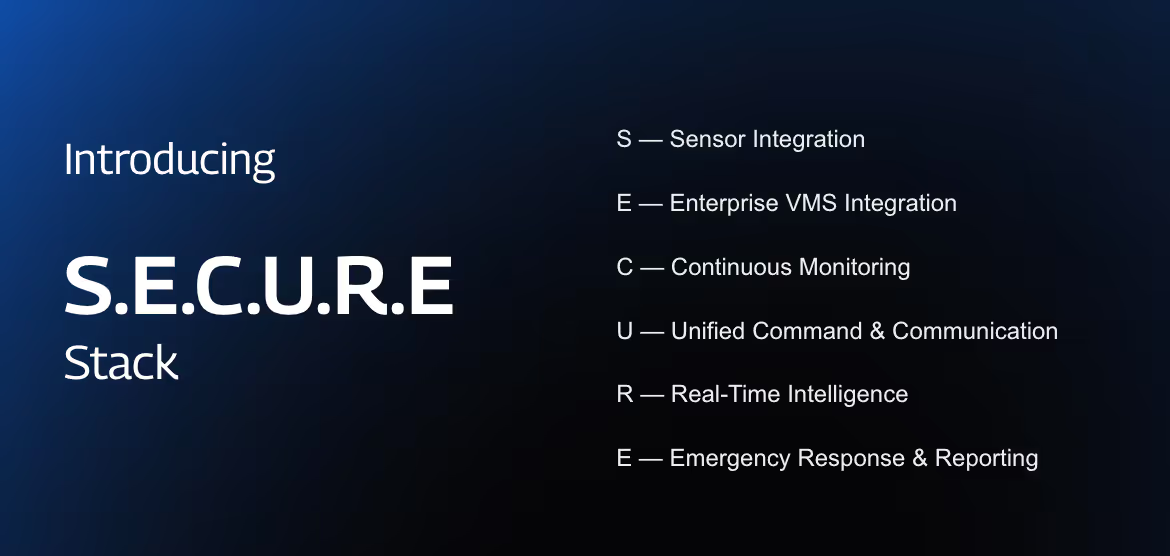
Across the most advanced sites worldwide, six elements have replaced the old “stack more tools” model. This is the S.E.C.U.R.E. Stack. It is becoming the operating foundation for modern 24/7 security.
When Systems Do Not Talk, Operations Slow Down
Most organizations already own the right components: CCTV walls, access control, motion sensors, alarm panels, guard patrols, and increasingly autonomous drones. The issue is not the hardware. It is the isolation.
From hundreds of operator and integrator conversations, five patterns appear again and again:
- Alerts appear in one system while footage records in another
- Operators juggle dashboards instead of threats
- Multi-site processes break down because each location runs its own playbook
- Costs keep scaling while visibility does not
- Drones remain underutilized because they sit outside the response loop
Teams detect plenty. They verify too slowly.
Why High-Performance Teams Are Moving to the S.E.C.U.R.E. Stack
Across airports, estates, refineries, and logistics corridors, six connected elements now anchor reliable operations. Together, they form a coherent architecture rather than another layer of hardware.
S — Sensor Integration
Alarms, radars, access events, and motion detections flow into one automation layer that turns each trigger into action.
E — Enterprise VMS Integration
Aerial feeds stream directly into Milestone, Genetec, or PSIM dashboards. Drones sit beside fixed cameras instead of living outside the command center.
C — Continuous Monitoring
Autonomous patrols close shift gaps with thermal sweeps, scheduled rounds, and adaptive missions during high-risk periods.
U — Unified Command and Communication
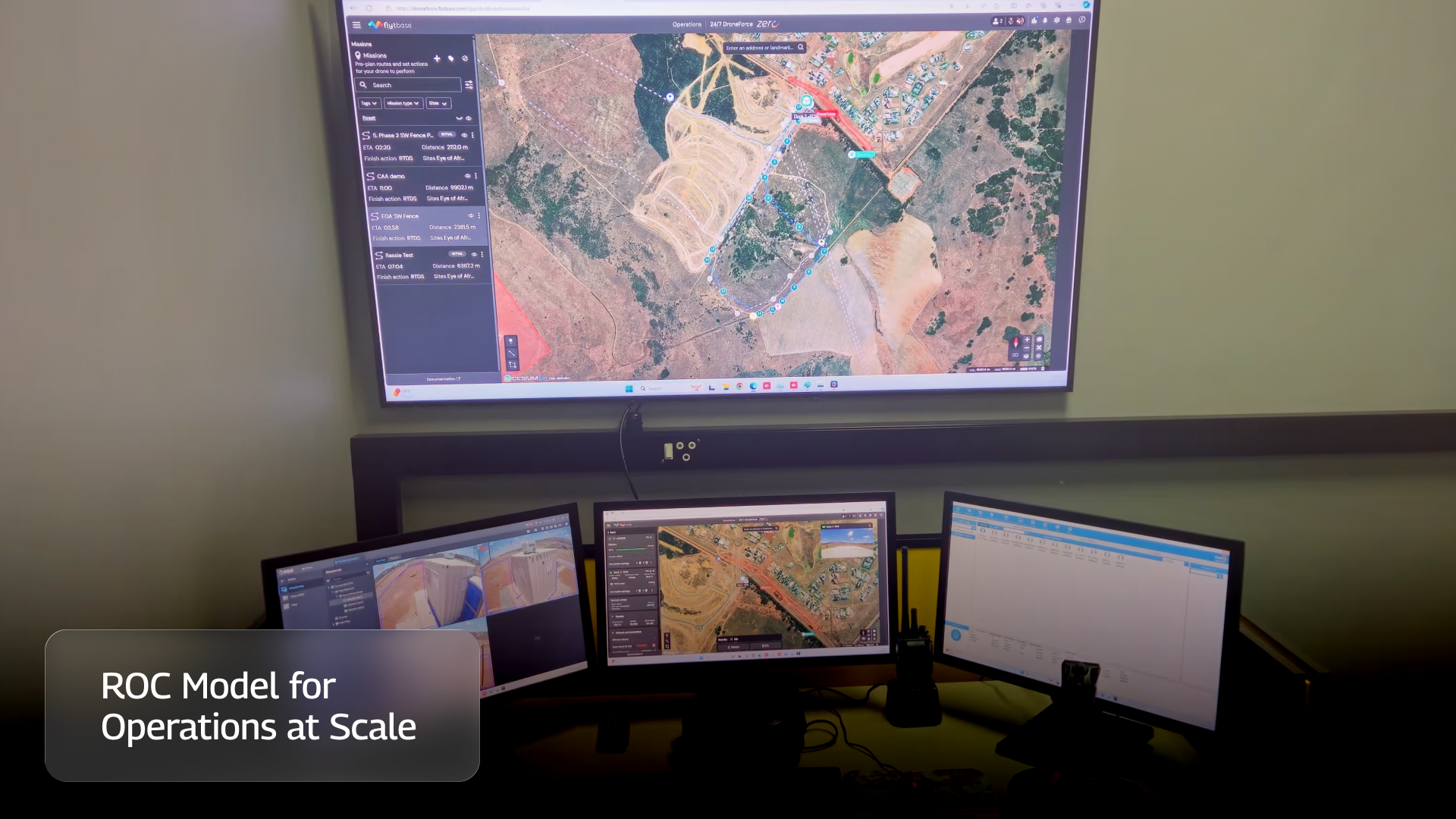
ROC operators and ground teams see the same event at the same time. Whether on VMS or mobile, everyone works from one picture.
R — Real-Time Intelligence
Aerial vantage points reveal what fixed cameras miss with dynamic repositioning, adjustable zoom, and on-demand context.
E — Emergency Response and Reporting
Every mission logs itself with footage, telemetry, flight paths, operator notes, and incident tags captured for audits and investigations.
These elements are not theoretical. They are live in FlytBase deployments that run thousands of autonomous flights each month.
How Leading Operators Use These Elements
Airports
- Perimeter alarms trigger autonomous launches.
- Thermal sweeps run overnight.
- Ground and aerial feeds merge inside the VMS.
Estates and Residential Security
- Proactive patrols run autonomously.
- Guards request drones on demand.
- Night missions shift automatically to thermal.
Refineries and Industrial Corridors
- Continuous perimeter sweeps support low-visibility hours.
- Alarm-triggered flights verify activity in seconds.
- Footage syncs with ERP and security logs for investigations.
Public Safety Agencies
- Remote ROCs oversee multiple zones.
- Drone-first verification reduces unnecessary dispatches.
- Evidence logs attach directly to case files.
The Connected Security Loop in Practice
When the S.E.C.U.R.E. elements connect, the full loop closes in seconds.
Detection → Verification → Response → Investigation → Audit → Improve
- Sensor detects
- Drone auto-launches
- Feed streams to ROC and responders
- Operator verifies immediately
- Ground teams move with aerial context
- Logs attach automatically
- SOPs improve based on real operations
This is the loop behind deployments like Premier Security’s connected response program, where rapid aerial verification prevented a potential $750,000 incident (case study).
A Practical 30 to 90 Day Path to a Connected Stack
Most teams assume connected autonomy requires a rebuild. It does not. Adoption is staged and predictable.
Phase 1: Map and Assess (Weeks 1 to 2)
- Identify blind spots, high-risk zones, and slow verification paths.
- Overlay drone coverage where autonomy provides immediate returns.
Phase 2: Connect and Integrate (Weeks 3 to 6)
- Integrate alarms, VMS, and autonomous drones into one orchestration layer.
- This is where alert-to-launch becomes real.
Phase 3: Operationalize (Weeks 6 to 10)
- Run hybrid missions.
- Train guards to request aerial support as standard practice.
- Test real-world scenarios.
Phase 4: Scale and Optimize (Weeks 10 to 12 and beyond)
- Roll out multi-site operations.
- Centralize through a single ROC.
- Add AI verification.
- Standardize best practices.
This progression mirrors how FlytBase deployments scale globally.
Insight Block: What Connected Security Changes Immediately
- Verification shifts from minutes to seconds
- Teams across sites finally share one operational picture
- Alarms trigger action instead of delays
- Patrols remain consistent regardless of staffing
- Every incident is documented without manual effort
Where This Fits Into the Future of Enterprise Security
Teams do not need more hardware. They need an architecture that turns existing sensors, cameras, and drones into one system.
The S.E.C.U.R.E. Stack is becoming that system. Always on. Adaptive. Built around human decision-making supported by autonomous aerial coverage.
To see how organizations are already making this shift, explore the case study above or the connected-security insights in the Autonomous Security Playbook.
FAQs
Find quick answers to common questions about compatibility, setup, features, and pricing
The S.E.C.U.R.E. Stack is a six-element framework used by leading security teams to connect sensors, VMS, drones, and communication tools into one operational system. It includes sensor integration, enterprise VMS integration, continuous monitoring, unified command, real-time intelligence, and automated reporting.
Siloed systems slow verification and force operators to switch between multiple dashboards. This delays response and creates blind spots across sites. A connected architecture reduces verification time from minutes to seconds and gives teams one shared operational picture.
Autonomous drones act as rapid verification tools that respond instantly to alarms or events. Their live feeds integrate into the VMS or ROC so operators see aerial and ground views in the same place. This improves accuracy and speeds up decision-making.
Most organizations complete the transition in 30 to 90 days. The rollout includes mapping blind spots, integrating existing systems, operationalizing hybrid missions, and finally scaling across multiple sites from one ROC.
.webp)
.svg)
.webp)
.png)
