
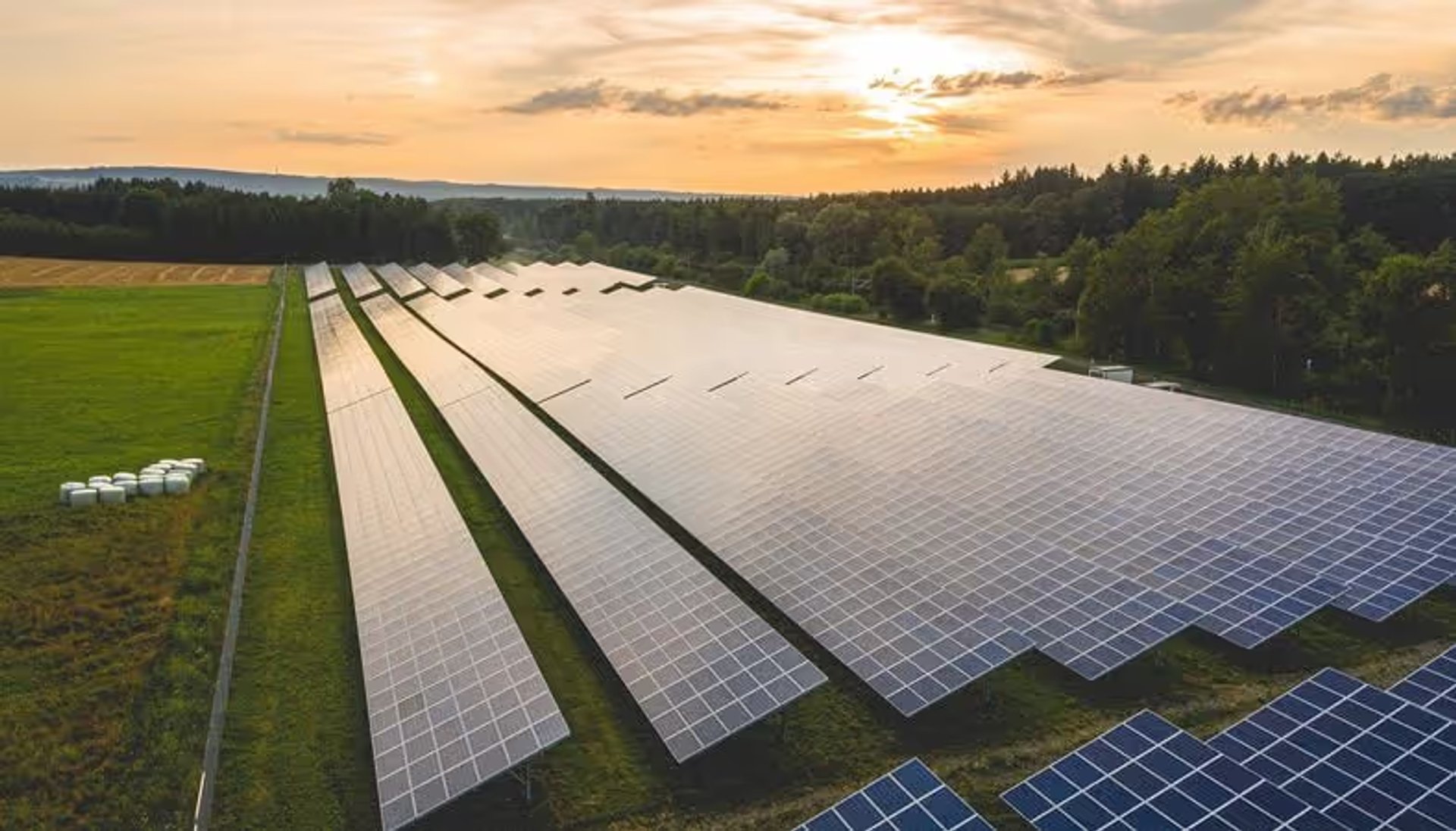

EnBW (Energie Baden-Württemberg AG) is one of Germany's largest energy companies, managing a rapidly expanding portfolio of renewable energy assets. With solar PV capacity growing from 150 megawatts to 1 gigawatt in just four years, the company faces significant challenges in inspecting increasingly larger installations with fewer people while maintaining data accuracy and operational efficiency. The renewable energy sector has seen a 67% increase in drone adoption over the past three years, with autonomous systems becoming essential for utilities seeking to scale inspection operations without proportional increases in workforce.
During a recent webinar, we spoke with Timo Freund, Technical Specialist for PV Modules at EnBW. Timo shared insights into how Germany's energy giant is leveraging autonomous drone dock technology to transform solar panel inspections across their rapidly expanding portfolio. Here's what he had to say about their journey with autonomous drone technology.
The challenge
"Our solar capacity exploded 7x in 4 years. We now have way more solar farms to inspect, and each farm is bigger than before-but we can't hire 7x more people to inspect them all," said Timo Freund, Technical Specialist for PV Modules, EnBW.
EnBW faced several critical challenges in managing their solar PV inspection operations:
Scalability Crisis: Traditional consultant-based inspection methods couldn't scale with the company's 567% portfolio growth over four years. Larger site footprints required exponentially more inspection time, yet consultant capacity couldn't expand fast enough. Inspection data remained trapped in Excel spreadsheets and PDF reports fragmented across email threads and SharePoint folders, creating coordination nightmares for maintenance teams trying to act on findings.
Germany-Specific Operational Constraints: The country's unpredictable weather made scheduling traditional drone pilots a gamble-clear sky days required for accurate thermal imaging were difficult to forecast, meaning pilots traveling two to six hours to remote sites often arrived to find conditions unsuitable for flying. Even worse, Germany's grid curtailment regime frequently shut down large solar installations during periods of negative pricing or grid congestion, leaving pilots on-site with no operational system to inspect.
Terrain and Connectivity Challenges: Some solar sites featured dramatic elevation changes-up to 80 meters of height difference-with mature trees obstructing line-of-sight communication between pilots and drones. Traditional remote piloting simply couldn't work reliably in these conditions.
Incomplete Data Quality: Consultant reports delivered only the top 200 failures detected during surveys, with additional anomaly tracking requiring extra payment. GPS coordinates weren't provided, forcing maintenance teams to interpret hand-marked site plans and attempt ground-level visual identification of specific modules-a process prone to error and time waste.
The solution
EnBW implemented a comprehensive autonomous drone-in-a-box solution powered by FlytBase's AI-powered drone autonomy platform and Sitemark's analytics software. The deployment strategically addresses the company's unique operational requirements while leveraging advanced autonomous capabilities to overcome Germany's challenging inspection environment.
The transformation happened in two distinct phases. Approximately two years ago, EnBW first transitioned from consultant-led ground surveys to drone-based aerial thermography. This initial shift replaced fragmented Excel and PDF workflows with GPS-tagged imagery and AI-powered anomaly detection through the Sitemark platform, delivering complete anomaly tracking of every thermal signature instead of just the top 200 failures consultants would manually log.
Building on this foundation, EnBW launched a proof-of-concept program deploying autonomous drone docks at high-value solar installations. The technical architecture centers on DJI Dock 2 systems equipped with LTE connectivity dongles-a critical innovation that solved the connectivity challenges posed by Germany's mountainous solar sites with up to 80 meters of elevation change and tree obstructions. Unlike the earlier 150-kilogram DJI Dock 1 that relied on line-of-sight communication, the Dock 2's LTE capability maintains constant connectivity with FlytBase's central monitoring system, enabling seamless remote flight operations without manual intervention.
FlytBase's platform provides the autonomous flight management capabilities essential for reliable operations from EnBW's Stuttgart headquarters. The system handles complex mission planning, automated flight execution, and real-time monitoring while maintaining regulatory compliance with Germany's aviation framework. Each dock is strategically positioned at sites ranging from 20 to 70 megawatts-the optimal size threshold where inspection flexibility and frequency justify the capital investment.
The deployed solution includes:
- Autonomous DJI Dock 2 systems with LTE connectivity
- FlytBase software platform for mission planning and remote execution
- DJI Matrice 4T/4TD drones with thermal and optical cameras
- Sitemark AI analytics platform for anomaly detection and ticketing
- Integration with EnBW's maintenance management workflows
How it works
The autonomous inspection workflow begins with pre-flight preparation conducted remotely from EnBW's Stuttgart office. The operator checks airspace regulations to confirm clearances from airports and restricted zones, then verifies weather conditions including wind speed and solar irradiance levels-missions require minimum 600 watts per square meter for accurate thermal imaging. Curtailment status is monitored through grid provider signals, allowing the team to identify inspection windows when the system will be energized. Flight missions are typically programmed one day in advance using FlytBase's planning tools.
On mission day, the operator remotely triggers the flight from Stuttgart. The autonomous dock opens, performs pre-flight system checks, and launches the DJI Matrice 4T or 4TD drone equipped with thermal cameras. The aircraft follows the pre-programmed flight path, maintaining 70% front overlap and 30% side overlap to ensure complete coverage. Flying at 25 meters altitude, the drone captures thermal imagery at 3-centimeter ground sample distance (GSD)-the resolution mandated by ISE (Fraunhofer Institute for Solar Energy Systems) norms for warranty-grade PV inspections.
Captured imagery is automatically uploaded to Sitemark's AI analytics platform upon mission completion. The software's machine learning algorithms process visual and thermal data simultaneously, detecting anomalies including hotspots, string failures, bypass diode issues, and glass breakage. Each detection is GPS-tagged to the precise module location and cross-referenced between thermal and visual images.
Maintenance teams access work orders through Sitemark's user-friendly interface, with exact GPS coordinates and photographic evidence. Field technicians can navigate directly to affected modules without interpretation guesswork, verify issues visually, and confirm repairs with post-service inspections-all coordinated through a single digital platform.
"I'm sitting here in Stuttgart, and I have sites close to Berlin. I don't want to drive there six hours and see weather conditions are bad or curtailment. I can just sit here in the office, start, and if I see the curtailment signal, I can stop and go on the next day," said Timo Freund, Technical Specialist for PV Modules, EnBW.
Implementation
The implementation process began with foundational capability-building before progressing to autonomous deployment. EnBW first transitioned from consultant-led inspections to in-house drone operations between 2020-2021, conducting extensive market research across European vendors before selecting Sitemark's analytics platform. The decision prioritized user experience and interface simplicity over feature breadth-a choice that proved critical for scaling adoption across maintenance teams with varying technical backgrounds.
During this period, EnBW established an internal pilot training program delivering comprehensive 5-day certifications covering European A1/A3 and A2 drone licenses, regulatory compliance and airspace management, photography fundamentals, thermography basics specific to PV inspection, and hands-on practical training at live solar facilities.
The autonomous dock pilot program launched in 2022-2023 with EnBW's first DJI Dock 1 deployment at a solar site with significant terrain challenges. The team quickly discovered the limitations of line-of-sight communication when flights descended to 25-meter inspection altitude across 80 meters of elevation change with intervening tree coverage. The solution arrived with fortuitous timing: DJI released the Dock 2 equipped with LTE dongle capability just as EnBW was grappling with these connectivity issues.
EnBW currently operates two autonomous docks with a third Dock 3 system deploying in spring 2024. The team has submitted Beyond Visual Line of Sight (BVLOS) approval requests to German aviation authorities, though processing backlogs mean approval timelines remain uncertain. The deployment operates on a separate LTE network outside EnBW's critical infrastructure (KRITIS) during the proof-of-concept phase, enabling faster testing and iteration without extensive cybersecurity approval processes.
"As I said, the next step would be that we are trying to deploy more of the drone docks. But first, we have to show it's beneficial. Our management will see if it's worth it to invest in docks, in software, in training people to do BVLOS flights and so on," said Timo Freund, Technical Specialist for PV Modules, EnBW.
The results
The implementation of autonomous drone dock technology has delivered significant measurable benefits across EnBW's operations:
Enhanced Operational Flexibility: The drone dock system eliminated the need for six-hour round trips to remote solar sites. Operating from Stuttgart, EnBW can now inspect sites near Berlin without travel costs or weather-related cancellations. When grid curtailment occurs mid-mission, flights simply pause and resume when conditions improve, enabling 2-4x increase in inspection frequency from annual to quarterly monitoring.
"I'm sitting here in Stuttgart, and I have sites close to Berlin. I don't want to drive there six hours and see weather conditions are bad or curtailment. I can just sit here in the office, start, and if I see the curtailment signal, I can stop and go on the next day," said Timo Freund, Technical Specialist for PV Modules, EnBW.
Complete Data Quality:
"The benefit is we now get all the failures on field tracked by the software. The AI of Sitemark is checking all the images and you will get every single failure down to a very low delta temperature tracked. This is something which the consultant companies never did," said Timo Freund, Technical Specialist for PV Modules, EnBW.
The AI-powered system now captures unlimited anomalies with GPS precision versus the top 200 failures from consultant reports. Cross-correlation of visual and thermal imagery automatically distinguishes vegetation shading from electrical failures, reducing false positives while ensuring no genuine issues escape detection.
Cost-Efficiency Validation: EnBW's financial modeling shows the break-even point is just one canceled pilot visit due to weather or curtailment. Dock investment approximately equals one year of external pilot costs for 20-70 MW sites, while enabling 2-4x more inspections at the same annual budget. The company managed 567% portfolio growth (150 MW to 1 GW) without proportional staff increases.
Unified Operations: EnBW built internal drone capability with several hundred drones deployed across business units. The company established a 5-day pilot training program and transitioned maintenance teams to dual-role pilot-technicians, reducing external contractor dependency while enabling opportunistic inspections during routine service visits. Two docks are currently operational with a third deploying spring 2024.
The way ahead
EnBW plans to expand the drone dock program across their entire portfolio of high-value solar sites, integrating the technology earlier in site development to maximize benefits. The company is refining the site size threshold model-validating the 20-70 megawatt range where dock capital investment delivers optimal returns-and standardizing inspection frequency protocols that balance cost with risk monitoring needs.
"We are training our maintenance teams to also become pilots. They are on-site, they are normally there when weather conditions are good because they have to do measurements on the strings, on the inverters. They can use this time and say, 'I just have the drone in my truck, and I will deploy it and do the inspection in parallel,'" said Timo Freund, Technical Specialist for PV Modules, EnBW.
Over the next one to two years, EnBW plans to scale dock deployment while expanding use cases beyond PV inspections. Substations, conventional power plants, and perimeter security applications are all under active evaluation, leveraging the same FlytBase automation platform and hardware investments. The company will also migrate from the POC's separate LTE network architecture to on-premises or secured configurations that satisfy cybersecurity requirements for integration with critical infrastructure systems.
Looking ahead, Freund anticipates that securing Beyond Visual Line of Sight (BVLOS) regulatory approval will significantly enhance operational capabilities by eliminating the need for on-site observers. The long-term vision positions autonomous inspection as standard operating procedure, with continuous condition monitoring replacing annual inspection cycles and platform investments seamlessly supporting solar, wind, grid infrastructure, and conventional assets across EnBW's multi-gigawatt portfolio
Conclusion
EnBW's implementation of autonomous drone dock technology has transformed solar PV inspections from a consultant-dependent, once-yearly process into a flexible, data-driven continuous monitoring operation. By eliminating travel constraints, operating around weather and curtailment windows, and capturing complete GPS-precise anomaly data, the company is building the operational foundation for managing multi-gigawatt renewable portfolios with fewer people and better insights.
The proof-of-concept deployment has validated core value drivers while revealing the path forward for energy companies navigating similar growth trajectories. As BVLOS approval unlocks full autonomy and deployment scales across business units, EnBW's phased approach demonstrates how properly implemented autonomous solutions can function as operational multipliers across different aspects of an organization.
"Take care about the lock-in effect of software. If you decide for one, then you're locked in and it's difficult to be more flexible. Take time for choosing the right one," said Timo Freund, Technical Specialist for PV Modules, EnBW.
Frequently asked
1. How does autonomous drone inspection compare to traditional consultant-based methods in terms of cost efficiency?
Autonomous drone docks serve as a force multiplier rather than a complete replacement for consultants, eliminating travel costs and enabling flexible scheduling around weather and curtailment. At EnBW, the break-even point is just one canceled pilot visit, with dock investment approximately equal to one year of external pilot costs for 20-70 MW sites while enabling 2-4x inspection frequency.
2. What technical infrastructure is needed to support remote drone operations for solar PV inspections?
Operations require DJI Dock 2 systems with LTE connectivity to overcome terrain and obstruction challenges, FlytBase's autonomous flight platform for mission planning and execution, and analytics software like Sitemark for AI-powered anomaly detection. Missions must maintain 3cm thermal GSD at 25-meter altitude to meet ISE norm requirements for warranty compliance.
3. How do energy companies address regulatory requirements for autonomous drone operations in Europe?
Companies must navigate aviation authority regulations including Beyond Visual Line of Sight (BVLOS) approval requirements. EnBW submitted BVLOS applications but faces processing backlogs, so currently operates with remote monitoring and on-site observers. The company established comprehensive pilot training programs and operates docks on separate networks during POC phase to accelerate testing before full KRITIS integration.
4. What is the typical return on investment timeframe for autonomous drone technology in solar operations?
While specific timeframes vary by portfolio size, EnBW's financial modeling shows break-even after a single weather- or curtailment-canceled consultant visit. The dual-use application for both detailed annual inspections and quarterly monitoring significantly accelerates ROI by increasing inspection frequency 2-4x, enabling faster anomaly detection and reducing energy production losses from undetected failures.